Introduction
Selecting an X-ray diffractometer (XRD) for your laboratory involves more than just comparing power ratings. The instrument’s goniometer geometry, detector technology, angular precision, and sample handling capabilities will determine whether it can reliably handle your phase identification, quantitative analysis, or advanced research applications. This buyer’s guide compares four AELAB XRD models – from a compact benchtop system to a fully configurable floor-standing platform – so you can make an informed decision based on your specific testing needs, sample types, and throughput requirements.
Quick Selection Summary
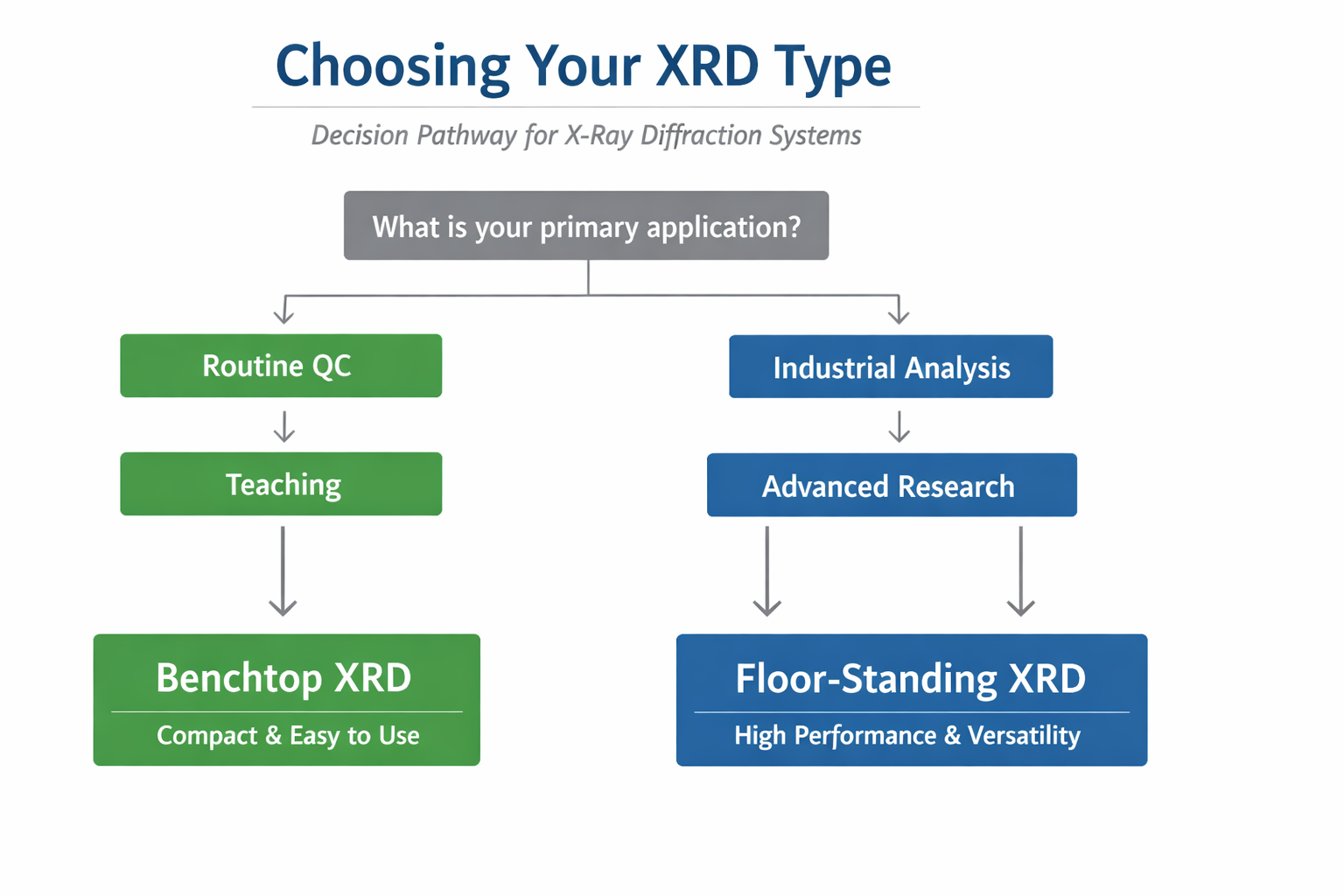
- For dedicated routine QC in catalyst, cement, or pharmaceuticals with limited space: Choose the benchtop AL-27mini with its built-in 6-sample changer.
- For teaching labs and basic materials analysis: The AL-3000 provides traditional θ–2θ geometry at an accessible price point.
- For high-power industrial applications and flexible sample types: The AL-2700 series (A or B) offers θ–θ goniometer convenience and optional high-speed detectors.
- For demanding research requiring extreme precision and multi-detector options: The AL-Y3500 delivers 0.0001° reproducibility and a wide accessory range.
Key Factors When Choosing an XRD System
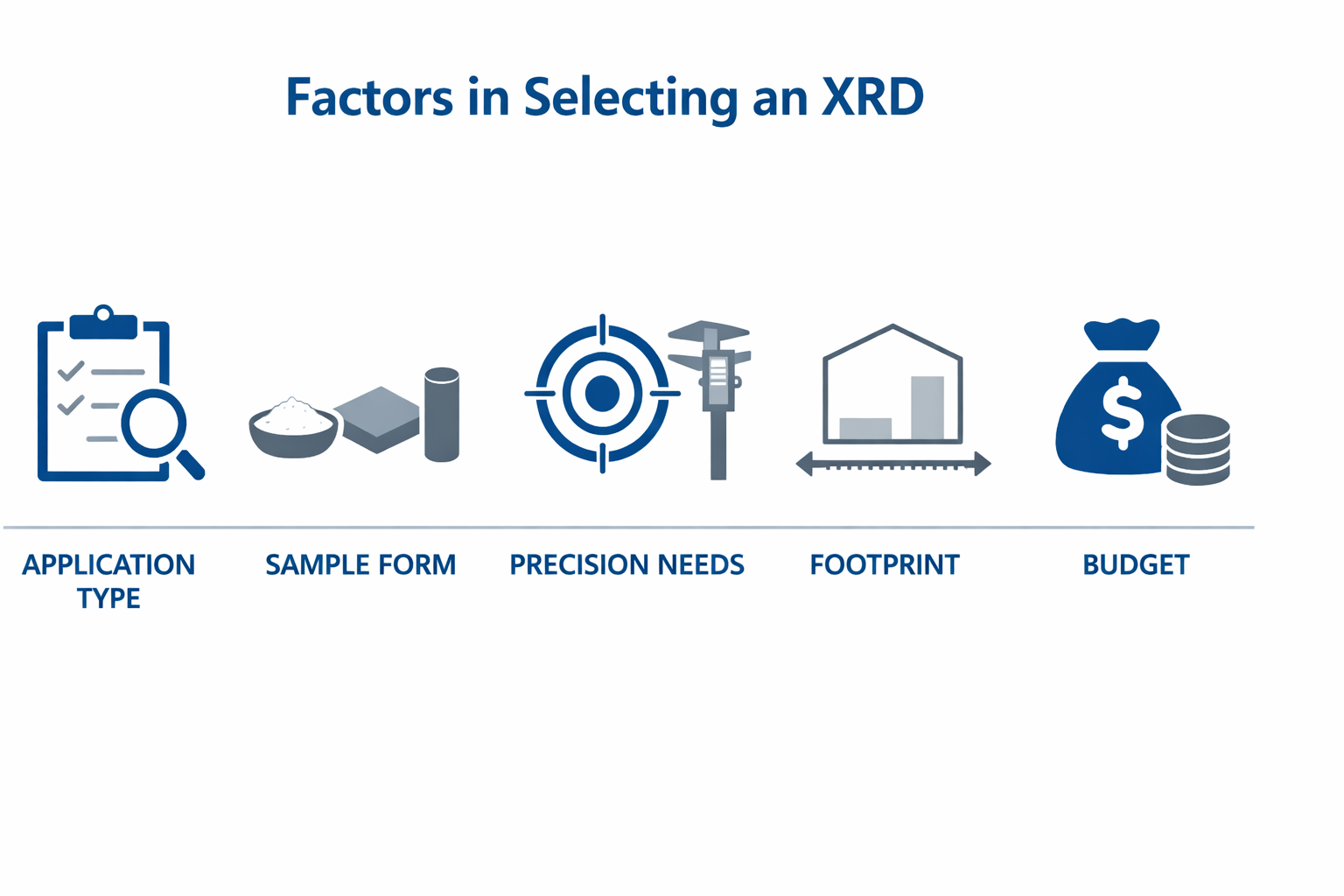
Before you evaluate specific models, it helps to understand which technical specifications directly impact your work. Here are the critical parameters to review:
1. X-ray Source Power
The rated power (typically 600 W to 4 kW) influences the intensity of the X-ray beam and, consequently, the speed of data collection and detection limits for minor phases. Higher power is beneficial for fast scans or weakly diffracting samples, but it also requires more robust cooling and electrical infrastructure. For routine QC work, 600–1200 W may be sufficient; for advanced research, 3 kW or higher is common.
2. Goniometer Geometry: θ–θ vs θ–2θ
The goniometer design determines how the X-ray tube and detector move relative to the sample. In a θ–θ configuration, the sample remains horizontal while the tube and detector rotate around it. This is ideal for loose powders, liquids, or samples that cannot be tilted. In a θ–2θ system, the sample rotates at half the rate of the detector, which can be simpler mechanically but may require careful sample preparation to avoid spillage. Choose θ–θ if you work with irregular or liquid samples; θ–2θ is perfectly adequate for standard solid specimens.
3. Angular Precision and Reproducibility
Minimum step size and angular reproducibility directly affect peak position accuracy and your ability to resolve closely spaced peaks. For precise lattice parameter measurements or phase quantification, look for instruments with reproducibility of 0.0001° or better. For educational or routine identification, 0.001° may be acceptable.
4. Detector Options
The detector type influences counting speed, energy resolution, and linear range. Point detectors like proportional counters (PC) or scintillation counters (SC) are robust and cost-effective. One-dimensional (1D) linear array detectors or silicon drift detectors (SDD) offer much faster data collection and better energy discrimination, making them preferable for high-throughput QC or trace phase analysis.
5. Sample Environment and Automation
Consider whether you need to run samples at non-ambient temperatures, in controlled atmospheres, or with automatic sample changers. The AL-27mini includes a 6-sample changer, while the AL-Y3500 and AL-2700 series can accommodate various environmental stages (check availability).
6. Laboratory Space and Utilities
Floor-standing models like the AL-3000, AL-2700, and AL-Y3500 require a stable bench or dedicated floor space and may need water cooling for the X-ray tube. The benchtop AL-27mini is air-cooled and fits on a standard lab bench, significantly reducing infrastructure demands.
For a closer look at how XRD fits into broader quality control workflows, see our guides on cement QC equipment and pharmaceutical QC.


AELAB XRD Models at a Glance
Comparing the AELAB XRD Systems
| Model | Type | Rated Power | Goniometer | Min Step Angle | Angle Reproducibility | Detector Options | Best For |
|---|---|---|---|---|---|---|---|
| AL-27mini | Benchtop | 600 W or 1200 W | θs–θd (θ–θ) | 0.0001° | 0.0001° | PC or 1D array | Routine QC with 6-sample changer; compact spaces |
| AL-3000 | Floor-standing | 3 kW | θ–2θ | 0.001° | 0.001° | PC or SC | Teaching labs, basic phase ID, cost-effective traditional analysis |
| AL-2700A | Floor-standing | 3 kW | θ–θ | 0.0001° | 0.0001° | PC, SC, SDD, 1D | Industrial QC, diverse sample types, high stability |
| AL-2700B | Floor-standing | 4 kW | θ–θ | 0.0001° | 0.0001° | PC, SC, SDD, 1D | High-power industrial analysis, fast scanning |
| AL-Y3500 | Floor-standing | 2 kW or 3 kW | θs–θd (θ–θ) | 0.0001° | 0.0001° | SC, 1D, SDD | Research labs, advanced texture/stress, max flexibility |
Product-specific values are based only on the provided product data and should be confirmed with AELAB before purchase.
Which Model Fits Your Lab?
Now that you have a technical overview, the decision comes down to your specific application, sample types, and budget. Here is how the models map to common scenarios:
Routine Quality Control with High Throughput
If your lab performs repetitive phase identification or quantification on catalyst, cement, or pharmaceutical samples and bench space is tight, the AL-27mini offers a ready solution. Its automatic 6-sample changer and compact footprint (640 × 500 × 770 mm) allow unattended operation right on the bench. The power options of 600 W or 1200 W are typically sufficient for these controlled applications, and the optional 1D detector can further speed up analysis.
Teaching and General Materials Characterization
For academic teaching labs or industrial facilities that need a straightforward XRD for standard materials, the AL-3000 provides reliable θ–2θ geometry at 3 kW. Its lower step resolution (0.001°) is practical for most undergraduate experiments and routine phase ID. While the detector choices are limited to PC and SC, these are robust and cost‑effective. The larger footprint requires a dedicated bench, but the overall cost of ownership is often lower.
Industrial Multi‑Purpose Analysis
Labs analyzing a wide range of materials—from metals and ceramics to geological samples—will benefit from the flexibility of the AL-2700 series. The θ–θ configuration keeps the sample flat, reducing preparation issues. The AL-2700A (3 kW) and AL-2700B (4 kW) share the same precision (0.0001° step/reproducibility) but differ in power and stability (0.005% vs 0.01%). The detector options (PC, SC, SDD, 1D) let you balance cost, speed, and energy resolution. If you work with low‑absorbing samples or need fast scans for high throughput, the 4 kW AL‑2700B with a 1D detector is attractive.
Advanced Research and Method Development
When your work involves thin films, residual stress, texture analysis, or non‑ambient experiments, the AL-Y3500 stands out. It offers the same 0.0001° precision but adds a wider measuring range (−110° to 168°), higher detector count rates (up to 15×10⁴ cps with SDD), and customizable X‑ray tube focus sizes. The ability to configure the system with a scintillation detector, 1D array, or SDD gives you the versatility to optimize for resolution, speed, or sensitivity. Its larger dimensions (1320×1150×1860 mm) require careful lab planning, but for research groups, the investment unlocks a broader range of experiments.
Need help choosing the right XRD configuration?
Tell us about your sample types, required detection limits, expected throughput, and any special conditions like high‑temperature or thin‑film analysis. Our team can recommend the most suitable model and detector option before you request a quote.
Conclusion
Selecting an X‑ray diffractometer is a balance between your analytical requirements, sample forms, and laboratory constraints. For dedicated QC, the benchtop AL-27mini provides automation and space efficiency. The AL-3000 offers a cost‑effective entry for teaching and basic analysis. The AL-2700 series gives high power and precision for industrial multi‑purpose use, while the AL-Y3500 is the go‑to for demanding research. Clarify your core application and sample characteristics first, then use the comparison table to shortlist models.
Do this next: Define your primary XRD application (phase ID, quantification, texture, stress, etc.) and note your sample form (powder, bulk, thin film, liquid). Use the comparison table above to narrow down models that match your precision and throughput needs, then reach out to AELAB for a configuration review and quotation.
Frequently Asked Questions
What is the difference between θ–θ and θ–2θ goniometers?
In a θ–θ goniometer, the X‑ray tube and detector rotate symmetrically around a stationary horizontal sample. This is ideal for loose powders, liquids, or samples that cannot be tilted. In a θ–2θ goniometer, the sample rotates at half the angle of the detector, which can be mechanically simpler but requires the sample to be firmly fixed. For most powder diffraction work, both geometries give equivalent results, but θ–θ is more forgiving for difficult sample forms.
How much does an X‑ray diffractometer cost?
XRD system prices vary widely based on power, detector, automation, and optional accessories. Benchtop models like the AL-27mini typically have a lower entry price than high‑end floor‑standing systems. For a specific quotation tailored to your application, contact AELAB with your requirements.
Can a benchtop XRD handle quantitative analysis as accurately as a floor‑standing model?
Yes, if the benchtop system has sufficient angular precision and an appropriate detector. The AL-27mini, with 0.0001° step size and an optional 1D detector, can perform quantitative phase analysis for many industrial QC applications. For trace‑level quantification or challenging samples with severe peak overlap, a higher‑power floor‑standing model with a SDD or 1D array may provide better detection limits and faster data collection.
What detector options are available for AELAB XRD systems?
Detector options vary by model. The AL-27mini supports a proportional counter or a high‑speed 1D linear array detector. The AL-3000 uses a proportional counter or scintillation counter. The AL-2700 series and AL-Y3500 offer the widest choice, including PC, SC, SDD (silicon drift detector) and 1D array detectors. Each detector type has trade‑offs in cost, count rate capability, and energy resolution, so the best choice depends on your application. Consult with AELAB for guidance.