If you need to quantify trace metals in water, soil, food, pharmaceuticals, or industrial materials, you have likely faced a choice between flame atomic absorption (FAAS) and graphite furnace atomic absorption (GFAAS). This article is for laboratory analysts, QC managers, and method developers who must decide which AAS technique fits their sample matrix, detection limits, throughput, and budget. By the end, you will have a clear technical understanding of both techniques, know when to use each, avoid common setup mistakes, and be able to evaluate integrated flame–furnace instruments as a practical solution for your trace metal workflow.
How Flame and Furnace AAS Work Differently
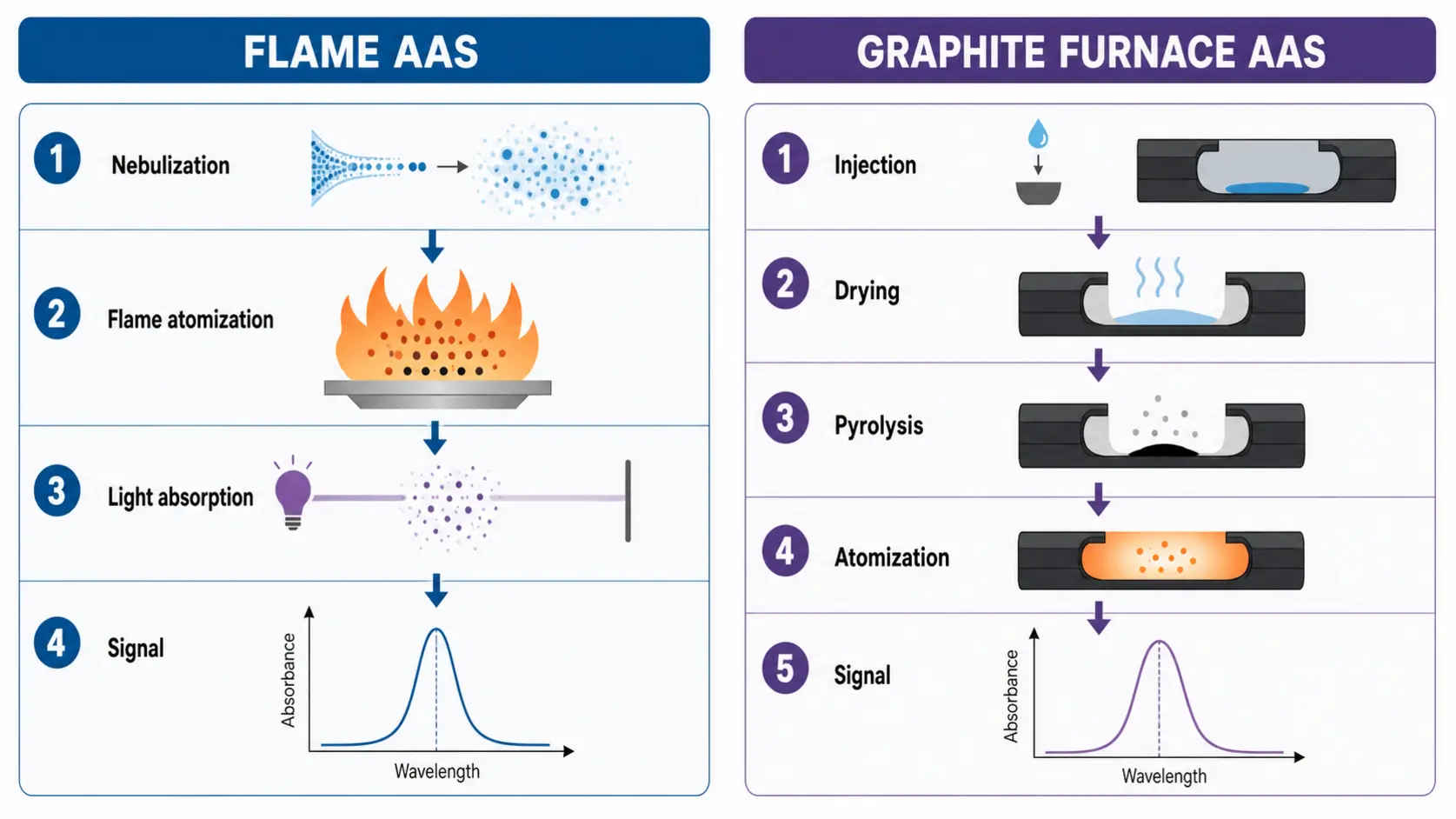
Flame AAS introduces a liquid sample as an aerosol into an air–acetylene or nitrous oxide–acetylene flame. The heat atomizes the sample, and a hollow cathode lamp emits light at a wavelength specific to the analyte element. The absorption signal is proportional to concentration. It is simple, fast, and well suited for mg/L (ppm) range analyses with good precision.
Graphite furnace AAS uses a small volume (typically 20 µL) injected into a graphite tube. The tube is heated in steps—drying, pyrolysis, atomization—in an inert gas atmosphere. Atomization occurs at very high temperatures (often up to 2800 °C) for a few seconds, producing a sharp, transient absorption peak. The technique achieves pg-level detection limits, 100–1000 times better than flame, and handles complex matrices with better background correction.
The core trade-off is speed versus sensitivity. Flame delivers results in seconds per sample; furnace runs take minutes. Flame tolerates higher dissolved solids; furnace is more prone to matrix interferences but excels at ultra-trace analysis. An integrated instrument that offers both techniques in one system provides flexibility to cover a wide concentration range without compromising on detection capability.
When Trace Analysis Demands Furnace AAS
Flame AAS often reaches a practical quantification limit of around 0.01–0.1 mg/L for many elements. When you need to measure concentrations below that—common in drinking water compliance, soil leachates, or pharmaceutical impurity profiling—graphite furnace becomes essential. It can reliably quantify at the µg/L (ppb) level and even lower for some elements like cadmium, lead, or arsenic.
However, furnace AAS is not automatically the right choice. The slower analysis cycle makes it less suitable for high-throughput labs. It requires more skilled operators and tighter control of matrix modifiers, tube conditions, and background correction. Many labs use a combined workflow: screen routine samples by flame, and escalate only those requiring lower detection limits to the furnace, all on the same instrument platform.
Common Pitfalls in Metal Analysis by AAS
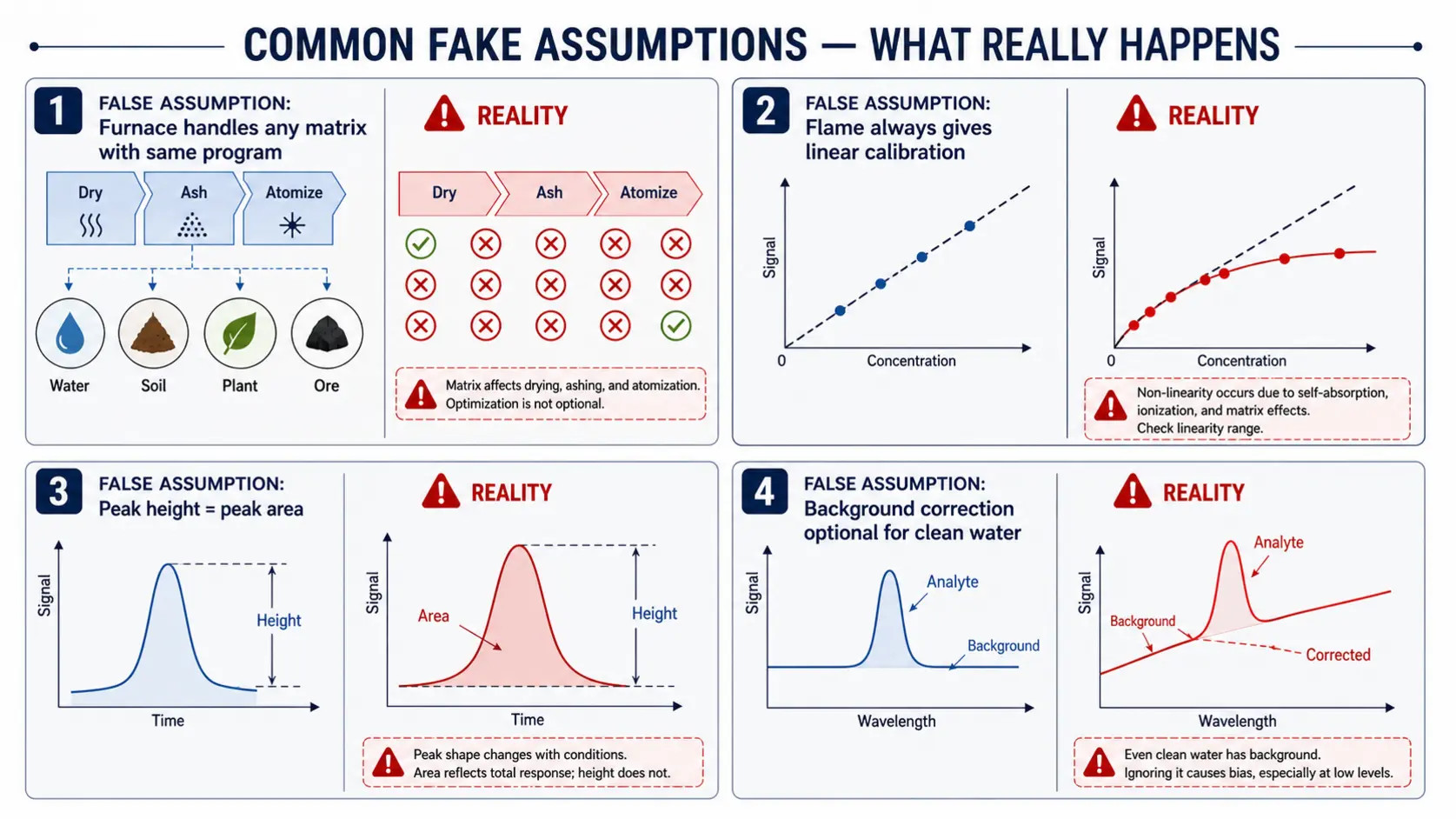
Even with mature technology, operators often make assumptions that lead to inaccurate results. Below are four common false assumptions we see in training and troubleshooting.
- “Furnace AAS can handle any matrix with the same temperature program.” In reality, matrix effects are severe. Volatile elements like Pb or Cd require modifier such as NH₄H₂PO₄ and optimized pyrolysis temperatures. High organic loads can build up carbonaceous residues that absorb light non‑specifically, mimicking analyte signal.
- “Flame AAS always gives linear calibration.” Many users expect a simple linear fit through zero. But ionization interferences (especially with alkali metals), flame stoichiometry changes, and lamp aging can cause non‑linearity. Method of standard additions is often necessary for complex samples.
- “Peak height and peak area give the same result in furnace AAS.” Inaccurate peak height integration can be skewed by the atomization rate and vapour transport dynamics. Peak area is generally more robust, but only with properly developed furnace programs.
- “Background correction is optional for clean water samples.” Even simple water matrices can produce structured background absorption from dissolved salts and organics. Deuterium or Zeeman‑effect background correction must be active by default, not only switched on after problems appear.
Operator Note: When switching from a routine flame method to a furnace method on the same integrated instrument, always purge the furnace gas lines and run a burn‑off cycle on a new graphite tube. Some volatile memory effects from earlier flame aspiration can carry into the furnace, giving false positives for zinc or cadmium.
Troubleshooting Flame and Furnace AAS Results
Below is a field‑tested troubleshooting reference for common performance failures.
| Symptom | Likely cause | Why it happens | Corrective action | Prevention tip |
|---|---|---|---|---|
| Low sensitivity in flame | Partially blocked nebulizer | Sample particles or dried salts restrict aspiration rate | Clean nebulizer with 1% HNO₃, back‑flush with solvent if needed | Filter samples through 0.45 µm membrane; rinse after high‑TDS runs |
| Poor reproducibility in furnace | Inconsistent injection volume | Pipettor malfunction or bubble in syringe | Check autosampler capillary for leaks; verify dispense volume gravimetrically | Regular autosampler maintenance; prime before each batch |
| High blank absorbance in furnace | Contaminated graphite tube | Metal carryover from previous high‑standard runs or residues from modifier | Condition new tube with a matrix‑free firing cycle; increase clean‑out temperature | Use separate tubes for different analyte groups; handle tubes with clean tweezers |
| Non‑linear calibration on Pb flame | Stray light or lamp degradation | Old hollow cathode lamp emits broader line width; flame background not corrected | Replace lamp; verify with a neutral density filter test; ensure D2 lamp aligned | Keep lamp current ≤ manufacturer’s maximum; log lamp hours |
| Memory effects in flame (Na, K) | Incomplete spray chamber drainage | Drain tubing clogged or air bubble in waste line | Clear drain and rinse with dilute HCl; repeat blank until stable | Use a drain loop with antistatic treatment; replace tubing quarterly |
| Double peaks in furnace atomization | Wrong modifier or pyrolysis temperature too low | Matrix components vaporize together with analyte producing secondary peaks | Increase pyrolysis temperature by 100‑200 °C steps; add modifier to stabilize analyte | Always run a temperature ramp optimization for new matrices |
| Erratic background in furnace | Tube platform contacts tube wall | Thermal expansion causes platform to touch graphite tube, distorting heating | Replace tube; select tube with proper platform‑to‑wall clearance | Use original manufacturer tubes; avoid re‑using expired tubes |
Workflow: Matching the Technique to Your Sample and Detection Limits
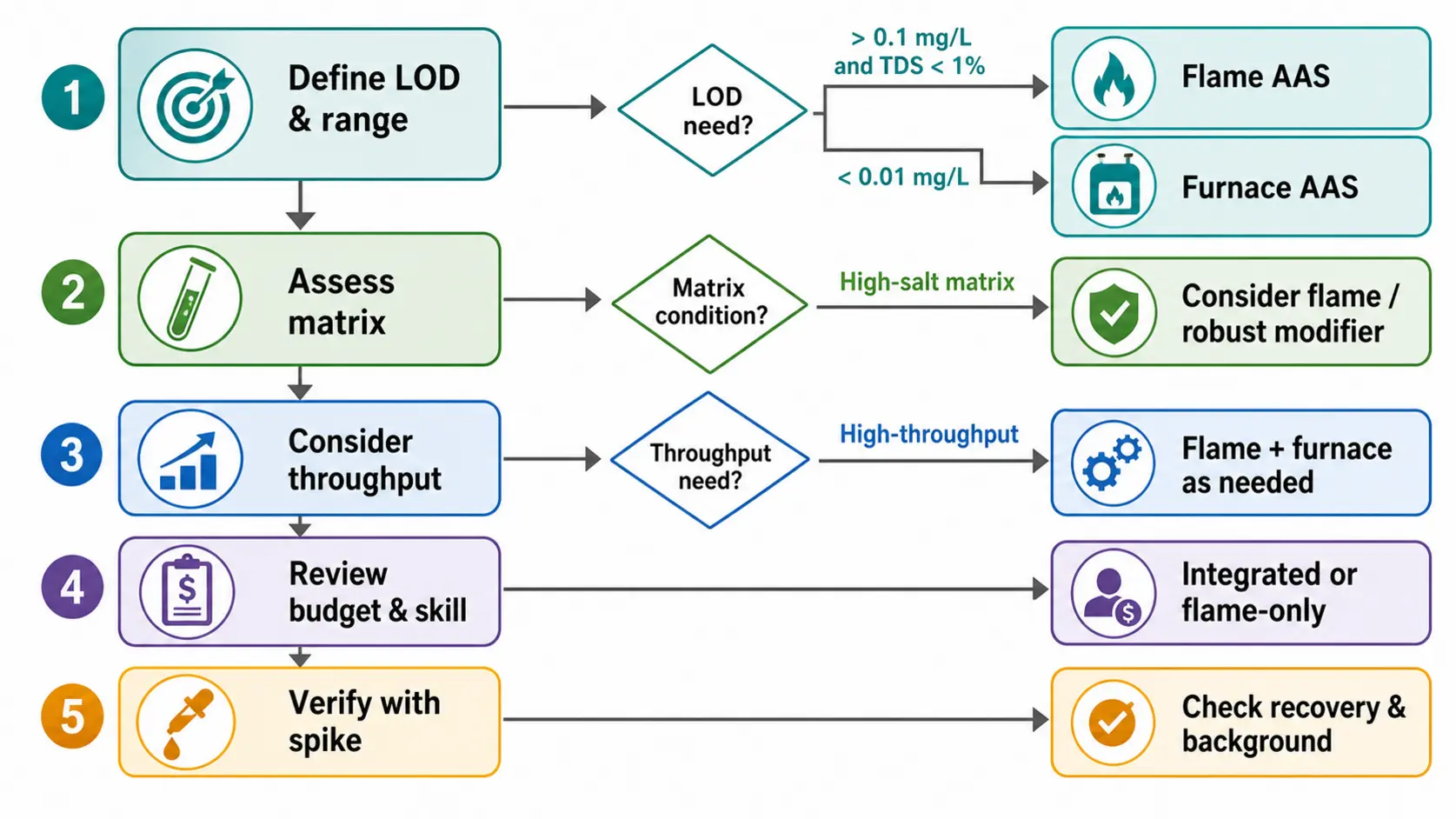
Making the right choice between flame and furnace—or deciding to use both on an integrated system—starts with understanding your sample characteristics and analytical goal. Follow this decision sequence to avoid a mismatch.
- Define required detection limit (LOD) and typical concentration range. If your target analyte is consistently above 0.1 mg/L and the sample has moderate dissolved solids (<1%), flame AAS is often the most efficient. If any analyte must be measured below 0.01 mg/L, or you are required to report µg/L levels by regulation, furnace AAS will be necessary.
- Assess matrix complexity. High‑salt samples (seawater, brines, industrial digests) can cause severe background in furnace AAS. Even with Zeeman correction, recovery may be poor without dilution or matrix matching. In such cases, consider flame first—or a furnace with a robust modifier program.
- Consider throughput. A busy environmental or food testing lab processing hundreds of samples daily may find pure flame workflow more productive, reserving furnace for the 10–20% of samples that require it. An integrated flame‑furnace instrument allows switching modes in minutes without recalibrating optics.
- Review available budget and operator skill. Furnace methods demand more hands‑on method development and maintenance. Labs with limited analyst experience may benefit from a simpler flame‑only system with automated dilution; however, an integrated system with guided software can reduce the learning curve.
- Verify with a method validation spike. Before finalizing the technique, spike a known matrix blank at the desired limit of quantification and check recovery, precision, and background signals. This quick test often reveals which technique will succeed in day‑to‑day use.
A common starting mistake is assuming that if a sample matrix is “clean enough,” the flame can be pushed down to furnace levels. In reality, flame sensitivity is limited by nebulisation efficiency and flame path length; no amount of scale expansion changes the fundamental detection limit. Recognize when you must switch to furnace to get reliable quantitative data.
Context Matters: Routine QC vs. R&D Work
How you operate a flame or furnace AAS depends heavily on the lab context. In a high‑throughput QC environment serving a drinking water plant, the priority is speed, ruggedness, and regulatory compliance. A flame method with proven EPA or ISO methods (e.g., EPA 239.1) and pre‑validated settings is ideal. An integrated system may be used only for the occasional low‑level antimony or selenium, the furnace program being a locked method that operators load but do not modify.
In contrast, an R&D lab developing new alloy digestion methods or studying metal uptake in biological matrices needs flexibility. They might switch frequently between flame and furnace, create new furnace programs, and experiment with modifiers. Here, an integrated instrument with open method parameters, automatic sampler for both modes, and powerful background correction is critical. Less stringent throughput means the slower furnace cycle is less of a burden.
For a contract lab, the ability to handle diverse client matrices and detection requirements makes a dual‑technique system a safer investment. They can bid on both routine metals packages and ultra‑trace projects without sub‑contracting. Training costs are higher initially, but the operational flexibility can justify the expense.
Evaluating Integrated Flame–Furnace AAS Instruments
An integrated instrument that houses both atomizers in one optical path eliminates the need to maintain two separate spectrometers, reduces footprint, and simplifies data management. When evaluating such a system, consider these practical aspects in addition to detection‑limit specifications:
- Switching speed and safety: How quickly can you change from flame to furnace mode? Are there automatic shutters to protect the optics from furnace emissions? Does the software handle gas control seamlessly?
- Background correction: Zeeman‑effect background correction is almost mandatory for complex furnace work. Check if the system uses a transverse or longitudinal Zeeman design, and how it performs with high‑background matrices.
- Autosampler capacity and programmability: An autosampler that prepares standards, adds modifiers, and performs dilutions automatically reduces operator error. For furnace work, the ability to use multiple modifier injections and hot‑injection techniques adds tremendous method scope.
- Lamp complement and alignment: Verify that the system can hold a sufficient number of hollow cathode lamps simultaneously and that lamp alignment is motorized or easily adjustable. Frequent manual lamp changes waste time.
- Software traceability: Regulatory labs need audit trails, electronic signatures, and direct output to LIMS. Even in non‑regulated environments, good data handling simplifies troubleshooting and trend analysis.
In many user laboratories, AELAB’s T8001S integrated atomic absorption spectrometer has proven to cover this ground efficiently. It combines a flame burner and graphite furnace atomizer in a single compact unit, with automatic switching between modes and a range of background correction options. The following table includes that system alongside other possible configurations to help you compare based on your most frequent analytical demands.


When assessing these instruments, do not get lost in specification sheets alone. Instead, ask: which technique will handle 80% of my routine workload? What are the most challenging samples I need to process? And what level of operator involvement am I ready to accept? An integrated system may be the right fit if you genuinely need both techniques regularly and want to avoid maintaining separate instruments.
Keeping Your AAS Reliable: Maintenance and Documentation
Many accuracy problems originate not from the atomizer but from neglected maintenance. For flame systems, weekly cleaning of the spray chamber and burner head with non‑abrasive solutions prevents salt buildup and flame instability. Always check the impact bead alignment; a misaligned bead reduces sensitivity by more than 30%.
For furnace systems, document the number of firings per tube and replace according to manufacturer recommendations, but also watch for signs like increasing blank absorbance or deformed peak shapes. Graphite furnace contacts must be clean and dry, as oxidation increases electrical resistance and skews heating profile. Keep a logbook with tube lot, analyte, modifier, and peak data to predict tube lifetime under your specific conditions.
Do this next: Pick one routine metal analysis you currently run by flame or furnace and map it against the decision workflow above. If your sample concentration is within a factor of 10 of the flame detection limit, run the same sample on a furnace and compare results. This simple cross‑check often reveals when you should have been using the other technique all along.
Conclusion
Flame and graphite furnace AAS remain reliable, well‑characterized tools for trace metal analysis. The key to accurate results is not in the technology alone but in knowing when to use which atomizer, how to set up background correction correctly, and how to maintain the system to avoid common failures. An integrated instrument can simplify this decision by giving you both techniques in one platform, but only if your lab workflow truly demands it. Ultimately, the best instrument is the one whose operating envelope matches your sample matrix, concentration range, and operational reality. Invest time in method development and operator training, and your AAS will deliver accurate metal analysis for years.
Frequently Asked Questions
What is the main advantage of graphite furnace AAS over flame AAS?
Graphite furnace AAS offers dramatically better detection limits—typically 100–1000 times lower than flame—making it suitable for ultra‑trace analysis at µg/L levels. It also handles very small sample volumes and, with proper background correction, can manage complex matrices that would otherwise give poor flame sensitivity.
Can I use a flame AAS system for all my trace metal work if I concentrate my samples?
Concentration by evaporation can lower the detection limit on paper, but it also concentrates matrix interferences and may introduce contamination. There is a practical limit to how far you can go before the blank signals and matrix effects become unmanageable. For analytes requiring ppb or sub‑ppb detection, furnace AAS is a cleaner solution than over‑concentrating a sample for flame.
How often should I replace the graphite tube in a furnace AAS?
Tube lifetime depends on the analyte, atomization temperature, matrix, and modifier used. A tube might last 300–500 firings for routine aqueous samples but far fewer with aggressive acids or high‑temperature elements. Monitor blank absorbance and peak shape rather than relying solely on a fixed number. As a rule of thumb, replace when blank absorbance doubles or peak shape begins to tail.
What type of background correction is best for furnace AAS?
Zeeman‑effect background correction is generally preferred for furnace work because it can correct high, structured backgrounds that deuterium systems struggle with, especially near the ends of the UV range. However, Zeeman systems are more expensive. For many environmental and food samples, a modern deuterium system with adequate optimization can give excellent results. Evaluate based on your sample’s background absorption profile.
When does it make sense to buy an integrated flame–furnace AAS rather than two separate instruments?
An integrated system is most cost‑effective when your lab regularly needs both techniques but cannot justify the space, maintenance, and software overhead of two independent spectrometers. It is particularly attractive for medium‑throughput contract labs, university core facilities, and industrial QC departments that handle a wide range of sample types and concentration levels. If you only rarely need ultra‑trace capability, a flame‑only instrument with occasional outsourcing may be more economical.
How do I know if my method is working correctly when I switch from flame to furnace on the same instrument?
Run a calibration verification standard immediately after switching modes, and check the blank. Slight signal drift is normal, but if sensitivity differs by more than 10–15% from the previous furnace session, check the autosampler, tube condition, and gas flows. Always run a control sample with a certified reference value to confirm the entire furnace train is performing correctly before trusting unknown results.