Quality Control Testing in Textile Manufacturing Overview
Quality control testing in textile manufacturing is a systematic process used to evaluate whether fibers, yarns, fabrics, and finished textile products meet defined quality, performance, safety, and compliance requirements. From incoming materials to finished products, laboratory testing provides objective data for production control, troubleshooting, product consistency, and release decisions.
For most textile QC programs, the main testing groups include physical and mechanical properties, colorfastness, dimensional stability, chemical properties, flammability, and appearance after care. The laboratory equipment required depends on the textile type, intended use, applicable test methods, production stage, and whether the laboratory performs routine QC or advanced analytical testing.
A practical textile QC laboratory therefore starts by defining the required tests and then matching each test to the appropriate instrument. Common equipment families include universal tensile testers, tear and bursting strength testers, launderometers, crockmeters, xenon arc testers, conditioning chambers, pH meters, spectrophotometers, flammability testers, and standardized washing and drying equipment.
What Is Quality Control Testing in Textile Manufacturing?
Textile quality control testing refers to the set of standardized laboratory procedures used to evaluate the properties and performance of fibers, yarns, fabrics, and finished textile products. These tests determine whether materials conform to specifications for strength, durability, comfort, appearance, and safety.
The testing scope covers raw material inspection, in-process monitoring, and final product verification. Common standards followed include ASTM, ISO, AATCC, and EN, depending on the target market.
The required test program is not identical for every textile product. Apparel, home textiles, technical textiles, nonwovens, upholstery, outdoor fabrics, and other applications may require different combinations of physical, chemical, colorfastness, dimensional, and safety testing.
Main Testing Requirements in Textile Quality Control
Textile testing requirements vary by product end-use, but most QC programs include physical, chemical, and performance assessments. Physical testing evaluates mechanical properties; chemical testing screens for harmful substances; and performance testing simulates real-world usage.
Typical requirements include tensile and tear strength, seam slippage, pilling resistance, color rub fastness, light fastness, shrinkage, pH value, formaldehyde content, and flammability. Apparel, home textiles, and technical textiles each have specific mandatory tests.
For laboratory planning, it is useful to connect each requirement to three questions: what property must be evaluated, which test method applies, and which instrument is needed to perform that test. This test-to-equipment mapping helps avoid purchasing instruments that do not match the actual QC scope.
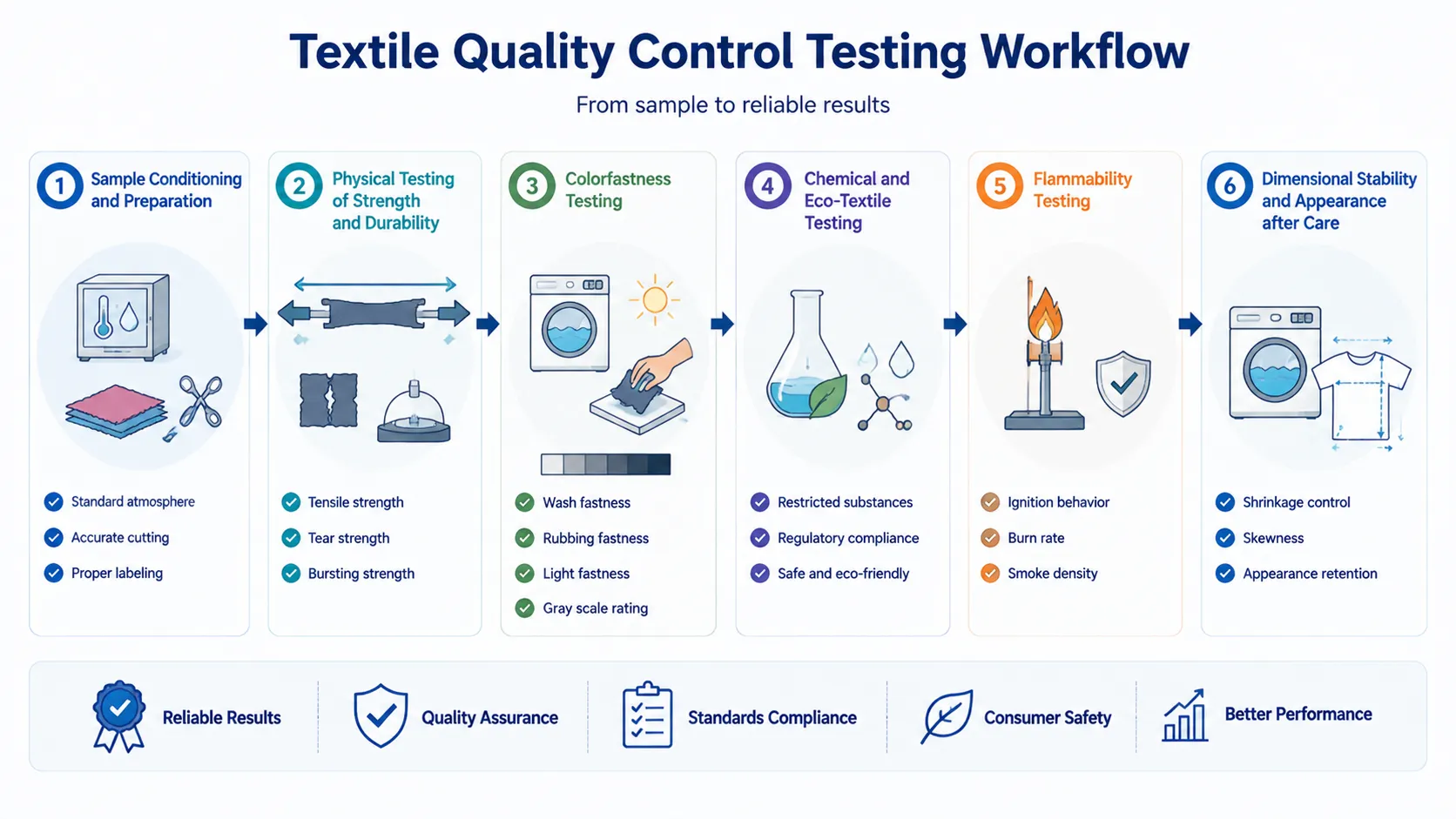
Textile Quality Control Testing Workflow
1. Sample Conditioning and Preparation
Before testing, textile samples must be conditioned in a standard atmosphere (usually 20±2°C and 65±4% relative humidity) for at least 24 hours to reach equilibrium moisture content. This ensures reproducibility of results across different laboratories.
QC checks include verifying environmental chamber settings and sample labeling. Recommended laboratory equipment:
- Constant temperature humidity chamber
- Precision cutting dies and templates
- Analytical balance
Sample preparation is important because specimen dimensions, conditioning, cutting direction, labeling, and handling can influence the reliability of subsequent physical and performance tests. Laboratories should therefore base preparation procedures on the applicable test method rather than using one preparation procedure for every textile.
2. Physical Testing of Fabric Strength and Durability
Physical tests measure the fabric’s ability to withstand mechanical forces. Tensile strength, tear strength, and seam slippage are critical for apparel and industrial textiles. Bursting strength is tested for knits and nonwovens.
Key QC checks involve proper grip distance, load cell calibration, and specimen alignment. Recommended equipment:
- Universal tensile testing machine
- Elmendorf tear tester
- Bursting strength tester
The appropriate strength instrument depends on the property being measured. A universal tensile testing machine is suitable for tests based on controlled tensile loading when equipped with the appropriate fixtures, while Elmendorf tear and bursting strength methods use different test principles and commonly require dedicated equipment.
3. Colorfastness Testing
Colorfastness tests evaluate how well a fabric resists color loss or transfer when exposed to washing, rubbing, perspiration, and light. Common methods include ISO 105-C06 for washing and AATCC 8 for crocking.
QC checks: standardized adjacent fabrics, rating under controlled lighting. Equipment:
- Launderometer or wash fastness tester
- Crockmeter
- Xenon arc light fastness tester
- Gray scale for color change and staining
Equipment selection should follow the exposure being evaluated. Washing, rubbing, and light fastness represent different service conditions and therefore require different test systems rather than a single general-purpose colorfastness instrument.
4. Chemical and Eco-Textile Testing
Chemical testing screens for restricted substances like formaldehyde, heavy metals, azo dyes, and phthalates. These tests ensure compliance with regulations such as REACH and standards like OEKO-TEX.
QC requires high-purity reagents and calibrated instruments. Equipment:
- UV-Vis spectrophotometer
- pH meter
- Gas chromatography-mass spectrometry (GC-MS)
- Liquid chromatography (HPLC)
The analytical equipment required depends on the target analyte and applicable method. A routine textile QC laboratory may perform selected basic chemical tests in-house, while more specialized restricted-substance analysis can require advanced analytical instrumentation, appropriate sample preparation, trained personnel, and supporting laboratory infrastructure.
5. Flammability Testing
Flammability testing assesses the ignition and burning behavior of textiles, especially for children’s sleepwear, upholstery, and protective clothing. Standards include 16 CFR 1610 and ISO 6940.
QC checks: burner calibration, specimen mounting, controlled environment. Equipment:
- Vertical flammability tester
- 45-degree flammability tester
- Smoke density chamber (for some applications)
Flammability equipment should be selected according to the product category and required test method. Different textile applications can use different specimen orientations, exposure conditions, and evaluation procedures, so the applicable method should be established before selecting the tester.
6. Dimensional Stability and Appearance after Care
Washing and drying tests simulate consumer care and measure shrinkage, skewness, and appearance retention. AATCC 135 and ISO 6330 are typical methods.
QC involves precise laundry cycle control and marking measurement points. Equipment:
- Washing machine and tumble dryer (standardized)
- Shrinkage scale or template
- Fabric drape meter (optional)
For reproducible results, laboratories should control the care procedure, specimen marking, measurement method, and evaluation conditions specified by the relevant test procedure.
Key Quality Control Tests for Textile Manufacturing
The following table maps common textile QC requirements to their purpose, typical laboratory equipment, and relevant applications.
| Quality Control Test | Purpose | Common Laboratory Equipment | Relevant Product Types / Applications |
|---|---|---|---|
| Tensile Strength | Measures force required to break fabric | Universal tensile tester | Apparel, industrial fabrics |
| Tear Strength | Evaluates resistance to tearing | Elmendorf tear tester | Outdoor textiles, workwear |
| Bursting Strength | Assesses strength under multidirectional load | Bursting strength tester | Knits, nonwovens, medical textiles |
| Colorfastness to Washing | Checks color loss and staining after laundering | Launderometer, gray scale | Apparel, home textiles |
| Colorfastness to Rubbing (Crocking) | Determines color transfer through friction | Crockmeter, white test cloth | Denim, dyed fabrics |
| Light Fastness | Simulates long-term sun exposure | Xenon arc tester, blue wool scale | Curtains, outdoor furniture |
| Dimensional Stability | Measures shrinkage or growth after wash/dry | Washing machine, shrinkage scale | All apparel and home textiles |
| pH Value | Ensures skin-friendly acidity/alkalinity | pH meter, extraction solutions | Baby clothing, intimate wear |
| Formaldehyde Content | Screens for harmful formaldehyde levels | UV-Vis spectrophotometer | Easy-care, wrinkle-free garments |
| Flammability | Assesses ignition and burn rate | Vertical flammability tester | Children’s sleepwear, upholstery |
Recommended Laboratory Equipment for Textile QC Laboratories
A textile QC laboratory does not necessarily need every available testing instrument. The appropriate equipment list should be built around the materials being tested, product end-use, applicable methods, testing frequency, and whether specialized analyses will be performed internally or externally.
| Laboratory Equipment | Main Application | Why It Matters |
|---|---|---|
| Universal Tensile Tester | Measuring tensile, tear, and seam strength | Provides critical data for fabric durability and compliance |
| Elmendorf Tear Tester | Measuring tear propagation resistance | Ensures fabrics withstand everyday snags and stresses |
| Bursting Strength Tester | Testing knit and nonwoven strength | Essential for stretchable and medical textiles |
| Launderometer | Colorfastness to washing tests | Simulates repeated laundering for quality assurance |
| Crockmeter | Dry and wet rub fastness testing | Prevents color transfer complaints |
| Xenon Arc Light Fastness Tester | Testing resistance to light and weathering | Critical for outdoor and automotive textiles |
| pH Meter | Determining fabric aqueous extract pH | Helps avoid skin irritation and meet safety standards |
| UV-Vis Spectrophotometer | Quantifying formaldehyde, extractable metals | Accurate chemical analysis for regulatory compliance |
| Vertical Flammability Tester | Measuring fabric ignition and burning rate | Mandatory for protective and children’s clothing |
| Washing Machine & Tumble Dryer (Standardized) | Preparing samples for dimensional stability and appearance tests | Reproducible care simulation per international standards |
| Constant Temperature Humidity Chamber | Conditioning samples to standard atmosphere | Eliminates moisture variability for reliable results |
| Analytical Balance | Weighing reagents and small fabric specimens | Precision for chemical testing and gravimetric measurements |
Basic vs Advanced Textile QC Laboratory Equipment
The difference between a basic and advanced textile laboratory is primarily the scope of testing performed in-house. A production mill focused on routine physical and colorfastness QC may prioritize sample conditioning, strength testing, wash and rub fastness, dimensional stability, and basic measurements. Laboratories responsible for broader chemical or restricted-substance analysis may require more advanced analytical instrumentation and supporting sample-preparation capabilities.
A practical purchasing sequence is therefore to define the required test list first, identify which tests must be performed routinely on-site, and then select equipment for those methods. Specialized instruments should be added when the testing scope, sample volume, customer requirements, or internal analytical strategy justifies them.
| Laboratory Level | Typical Testing Focus | Equipment Priorities |
|---|---|---|
| Core / Routine QC | Conditioning, physical strength, colorfastness, dimensional stability, basic measurements | Conditioning equipment, tensile/strength testers, launderometer, crockmeter, standardized laundry equipment, pH meter, balance |
| Application-Specific QC | Tests required for particular textile types or end uses | Tear, bursting, light fastness, flammability, or other application-specific testers as required |
| Advanced Analytical Laboratory | Chemical characterization and specialized substance analysis | UV-Vis spectrophotometer, HPLC, GC-MS, and associated laboratory infrastructure according to the required analytical methods |
How to Choose Laboratory Equipment for Textile Quality Control
Selecting the right laboratory equipment starts with identifying the facility’s testing scope, textile types, and target test methods. Instead of selecting instruments from a general equipment list, map each required QC test to the instrument needed to perform it.
For a mill performing routine physical tests, universal tensile testers, conditioning equipment, and standard colorfastness or laundry-testing systems may form part of the core laboratory. A third-party testing laboratory or facility expanding into chemical analysis may require advanced analytical instruments such as a UV-Vis spectrophotometer, HPLC, or GC-MS together with suitable sample-preparation and safety infrastructure.
Consider the following factors when planning the laboratory:
- Required tests: Define which properties must be measured before selecting equipment.
- Textile and product type: Woven fabrics, knits, nonwovens, apparel, upholstery, and technical textiles can require different test combinations.
- Applicable test methods: Confirm that the instrument configuration is suitable for the methods used by the laboratory.
- Sample volume and throughput: High-volume laboratories may benefit from equipment and workflows that reduce repetitive handling and simplify data management.
- Calibration and repeatability: Instruments should support the laboratory’s measurement-control and calibration requirements.
- Fixtures and accessories: Confirm that the required grips, holders, templates, or other method-specific accessories are available for the intended tests.
- Maintenance and technical support: Consider spare parts, routine maintenance, service availability, and operator training.
- Future testing scope: Plan space, infrastructure, and purchasing priorities so additional testing capabilities can be introduced as requirements expand.
A modular approach can keep the initial laboratory configuration focused on routine QC while allowing specialized physical, chemical, light-fastness, or flammability capabilities to be added when needed. AELAB can help evaluate the required test scope and identify suitable laboratory equipment categories for a textile QC laboratory.
Frequently Asked Questions
What are the most common quality control tests in textile manufacturing?
The most common tests include tensile strength, tear strength, colorfastness to washing and rubbing, dimensional stability, pH value, and flammability. The exact set depends on the product type and target market regulations.
Why is sample conditioning important before textile testing?
Conditioning in a standard atmosphere (20°C and 65% RH) ensures all samples reach a consistent moisture equilibrium. This eliminates environmental variability and guarantees that test results are reproducible and comparable between labs.
Which international standards apply to textile quality control?
Key standards include ASTM D series for physical properties, AATCC for color and wet processing, ISO for a broad range of tests, and EN for the European market. Flammability follows 16 CFR 1610 in the US and EN 71 for toys.
How often should textile testing equipment be calibrated?
Calibration frequency depends on equipment usage and manufacturer recommendations but typically ranges from every six months to annually. Critical instruments like load cells and spectrophotometers may need more frequent checks to maintain accuracy.
Can one universal testing machine perform all textile strength tests?
A universal tensile tester can perform tensile, tear, and seam slippage tests with appropriate grips and fixtures. However, specialized tests like bursting strength or Elmendorf tear often require dedicated instruments for higher accuracy and compliance with specific standards.
What is the role of chemical testing in textile quality control?
Chemical testing ensures that textiles are free from harmful substances such as formaldehyde, heavy metals, and banned azo dyes. It is essential for meeting eco-certifications like OEKO-TEX and regulatory requirements like REACH, protecting both consumers and brand integrity.
Conclusion
Quality control testing in textile manufacturing connects production requirements with measurable laboratory data. An effective QC program should define what needs to be tested at each relevant stage, select the appropriate test method, and then match that method to suitable laboratory equipment.
For laboratories planning new equipment, the most practical approach is to begin with the routine tests required for the facility’s actual textile products and then expand into specialized testing as the scope grows. Physical testing, colorfastness, conditioning, and care-performance equipment may form the core of many textile QC laboratories, while advanced chemical and application-specific instruments should be selected according to the laboratory’s analytical responsibilities and target requirements.
This test → method → equipment approach helps manufacturers and testing laboratories build a more focused laboratory configuration instead of purchasing instruments without a defined testing need.