

If you measure the energy content of coal, petroleum coke, or liquid fuels, you already know that the calorific value is the single most important number for quality, pricing, and regulatory compliance. For analysts and technicians who need to run bomb calorimeter tests reliably—or who are setting up a fuel testing workstation—this article explains exactly how an oxygen bomb calorimeter determines the heat of combustion, where the workflow commonly breaks, and how to avoid expensive repeat runs.
The Basic Working Principle of an Oxygen Bomb Calorimeter
At its core, a bomb calorimeter measures the heat released when a precisely weighed sample burns completely in an oxygen‑rich environment. The instrument is built around a sealed stainless‑steel vessel—the bomb—that can withstand the high pressure and temperature produced during the reaction. The bomb is placed inside a known quantity of water, and the entire assembly sits in a well‑insulated jacket to isolate the heat exchange from the surroundings.
When the sample ignites, the temperature of the water rises. By precisely tracking that temperature increase and knowing the heat capacity of the entire calorimeter system, you can calculate the total energy released. The working principle is direct: measure the temperature change, apply a known energy equivalent, and correct for side reactions and heat losses. For coal and petroleum testing, the result is reported as gross calorific value (GCV) or net calorific value (NCV), depending on whether the latent heat of water vapor is included.
Operator Note: The bomb must be purged with oxygen to displace ambient air; residual nitrogen can form nitric acid, which creates an unwanted exothermic side reaction and skews the final result.
How the Calorific Value Is Determined from Temperature Change
The calculation is a simple energy balance, but the real skill lies in controlling every variable that affects the temperature reading. The calorimeter system is first calibrated with a reference material—typically benzoic acid—of known calorific value. This gives the energy equivalent or water equivalent of the entire system. Then, for an unknown sample, the corrected temperature rise is multiplied by that energy equivalent, and minor corrections are applied for fuse wire combustion, acid formation, and sometimes soot if combustion is incomplete.
Modern calorimeters automate the temperature‑reading process using a platinum resistance thermometer or thermistor and apply the Regnault‑Pfaundler or Dickinson method for heat‑leak correction. However, the underlying physics remains: the heat from the bomb is absorbed by the water, and the temperature sensor detects it with a resolution typically down to 0.0001 °C. If the water is not well mixed or the temperature sensor drifts, the entire measurement becomes questionable.
Sample Preparation and Handling for Coal and Petroleum
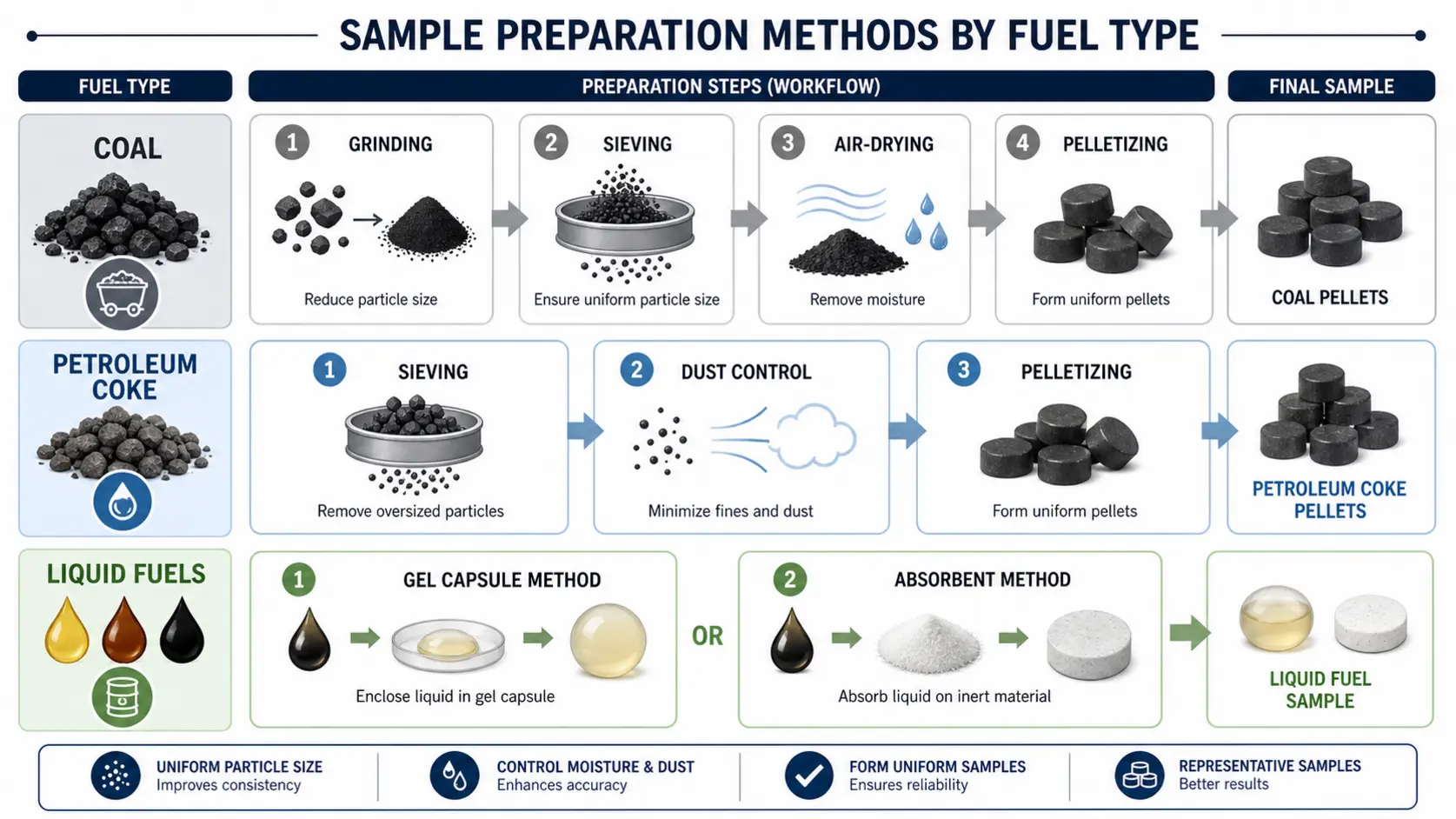
How you prepare the sample is as critical as the instrument itself. Coal must be ground to the required fineness—often passing a 250 µm sieve—and air‑dried to a consistent moisture level. Petroleum coke may need sieving to remove fines that can cause dust explosions during pressing. Liquid fuels are weighed in a gel capsule or onto an inert absorbent to prevent premature evaporation and to control combustion rate.
A common mistake is to assume that any small variation in sample mass is acceptable. In practice, the sample mass must be chosen so that the temperature rise during the test falls within the calibrated range of the calorimeter. Over‑ or under‑loading the bomb leads to non‑linear response or incomplete combustion. Also, for solid fuels, the sample must be compressed into a pellet or briquette to avoid spattering during ignition.
Operator Note: For petroleum coke, wipe the crucible and sample press with a dry cloth between samples. Cross‑contamination from a previous high‑sulfur sample can alter the ignition pattern of the next run.
Step‑by‑Step Test Workflow

Below is the typical workflow for a single calorimetric run, from sample weighing to result verification. Following it consistently is the best defense against random variation.
- Weigh the sample to a precision of 0.1 mg and record the exact mass.
- Prepare the bomb: Place the sample in the crucible, attach the ignition wire so it touches the sample without shorting, and insert the bomb head.
- Charge with oxygen: Purge the bomb once or twice, then fill to the required pressure (commonly around 3 MPa or 30 bar) without over‑pressurizing.
- Fill the calorimeter vessel with a fixed mass of water and place the bomb inside, checking for gas leaks.
- Assemble the system: Connect the ignition leads, close the jacket, and start the stirrer.
- Equilibrate and fire: Wait for a stable temperature baseline, then fire the charge. The temperature rise is recorded until it stabilizes again.
- Open the bomb: Inspect the crucible for unburned residue; any soot or coked material means incomplete combustion and a void test.
- Titrate the washings if the standard requires acid correction (for nitric or sulfuric acid).
- Calculate the gross calorific value and apply standard corrections.
Many inexperienced users skip the post‑run bomb inspection. That is the single largest source of overlooked measurement error. Even a trace of unburned carbon can reduce the measured calorific value by several percent.
Common Pitfalls and False Assumptions in Bomb Calorimetry
Laboratories often assume that the instrument is so automated that operator technique no longer matters. In reality, several false beliefs can silently erode data quality:
- “The oxygen pressure setting is not critical.” Insufficient pressure leads to incomplete combustion; excessive pressure can blow the sample out of the crucible or cause dangerous mechanical stress. The pressure is part of the method, not a convenience.
- “The calorimeter maintains its calibration for months.” The energy equivalent drifts with changes in room temperature, stirrer wear, and sensor aging. It must be rechecked regularly—typically once per day or after any maintenance.
- “All coal samples behave the same.” High‑ash coals, weathered lignite, and anthracite can ignite differently. The ignition wire energy may need adjustment to ensure complete burnout.
- “If the temperature rise looks normal, the result is valid.” Without a post‑run bomb inspection and acid titration, hidden systematic errors from incomplete combustion or acid formation can persist through hundreds of runs.
Troubleshooting Unreliable Calorific Value Results
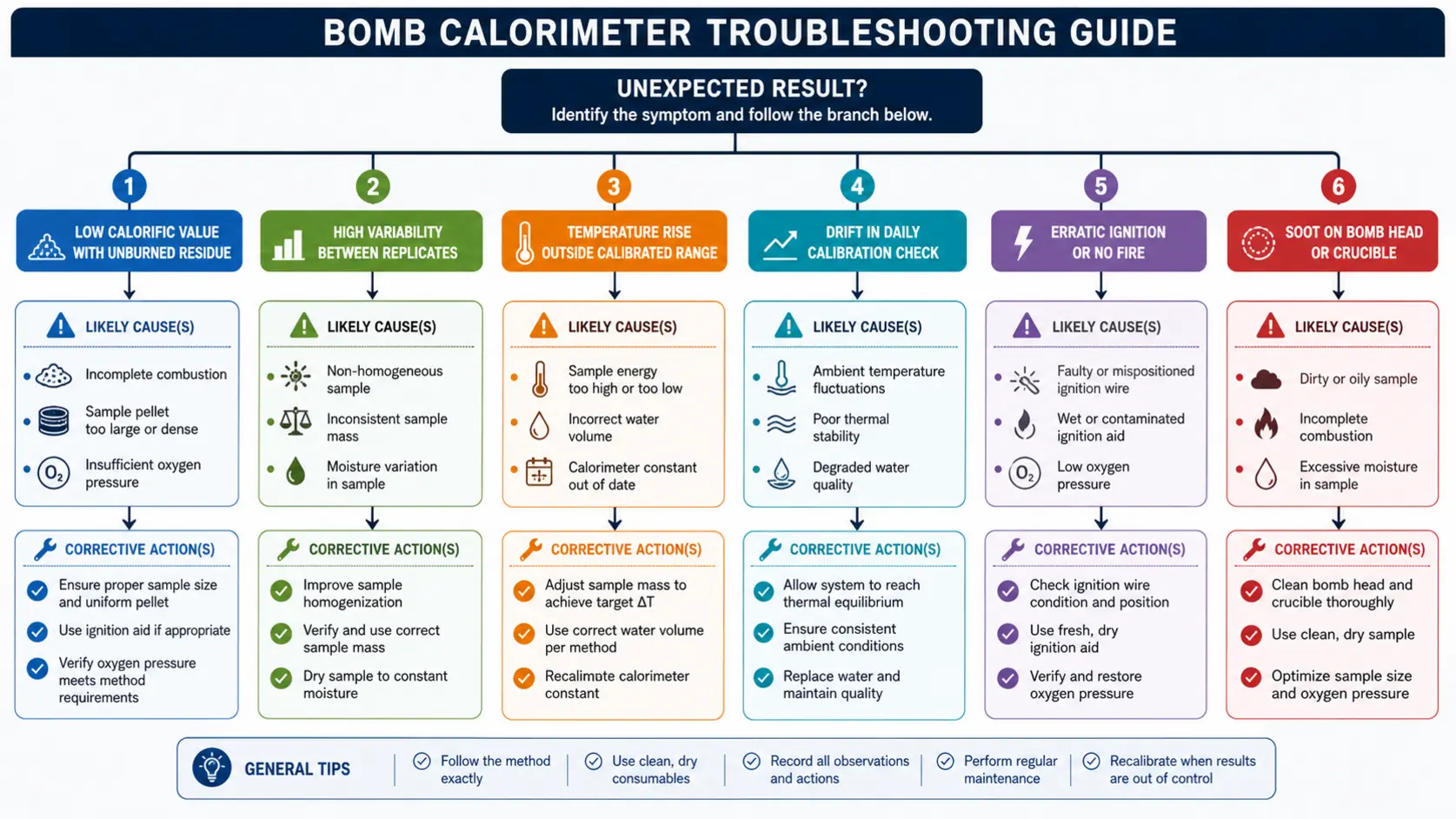
Even a well‑maintained bomb calorimeter occasionally produces questionable results. The table below lists the most frequent symptoms and their typical root causes.
| Symptom | Likely Cause | Corrective Action |
|---|---|---|
| Low calorific value, unburned residue in crucible | Insufficient oxygen, poor sample‑wire contact, or wet sample | Check oxygen pressure, re‑seat ignition wire, dry sample longer |
| High variability between replicates | Inconsistent sample mass, stirrer fault, or water mass variation | Weigh samples exactly, inspect stirrer, refill water with calibrated balance |
| Temperature rise outside calibrated range | Sample mass too large or too small | Adjust mass to bring temperature rise within 2–3 K of calibration point |
| Drift in daily calibration check | Sensor aging, room temperature swing, or bomb seal degradation | Recalibrate, stabilize room, replace O‑rings |
| Erratic ignition or no fire | Broken fuse wire, poor electrical contact, or wet sample | Replace wire, clean terminals, ensure sample is dry |
| Soot on bomb head or crucible | Sample spattering, too‑rapid combustion | Pelletize sample properly, lower oxygen pressure slightly |
Whenever a result falls outside the expected repeatability, go back to the bomb inspection. An instrument that automates the temperature reading cannot automate away the reality of incomplete combustion.

Selecting the Right Bomb Calorimeter for Your Fuel Testing Lab
Not all oxygen bomb calorimeters are built for daily fuel testing. When you move beyond teaching principles and into routine QC or commercial analysis, the differences in automation, data handling, and safety matter. For a coal or petroleum testing lab, the choice often comes down to throughput, required precision, and how much operator judgment the instrument can safely replace.
A basic manual calorimeter requires the operator to perform every step—from water filling to temperature reading and calculation—but it gives full visibility into the process and is easier to troubleshoot. Automated instruments reduce labor and improve repeatability, but they may hide developing problems such as a slow stirrer or a fouled sensor until results drift noticeably. The right balance depends on your sample load, operator skill, and whether the results will support commercial transactions.
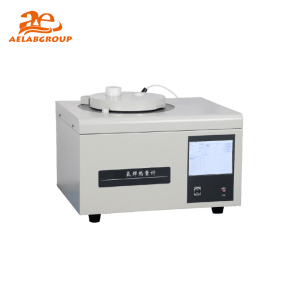
The oxygen bomb calorimeter models we maintain for fuel laboratories are engineered for both education and routine petroleum or coal testing. They typically include integrated temperature measurement with 0.0001 °C resolution, automatic heat‑leak correction, and safety interlocks that prevent firing if the bomb is not properly sealed. If your lab tests a wide range of sample types—from bituminous coal to diesel fuel—look for a model that stores multiple calibration protocols and allows you to switch seamlessly between them.
Conclusion
A bomb calorimeter appears simple, but its reliable use in coal and petroleum testing demands more than following the on‑screen prompts. Understanding the working principle, controlling sample preparation, inspecting the bomb after every run, and re‑calibrating far more often than many labs do—these habits separate a trustworthy result from a number that merely looks correct.
Do this next: If your laboratory is setting up bomb calorimetry for fuels or reviewing existing data quality, start by checking your daily calibration records and bomb inspection logs. Identify any runs that skipped post‑combustion bomb checks, and tighten the workflow at that point before adding new samples.
Frequently Asked Questions
What is the difference between gross and net calorific value?
Gross calorific value (GCV) includes the latent heat of condensation of the water vapour produced during combustion. Net calorific value (NCV) subtracts that heat, giving a lower number that better represents usable energy in practical combustion systems.
How often should I calibrate the bomb calorimeter?
Calibrate with benzoic acid at least daily when the instrument is in regular use, and after any component change, cleaning, or maintenance. Sudden room temperature changes also require a recalibration check.
Can a bomb calorimeter test both coal and liquid fuels?
Yes, but the sample preparation is different. Coal is pressed into a pellet, while liquid fuels are burned in a gel capsule or on an inert absorbent. The igniter energy and oxygen pressure may also need adjustment depending on the standard method.
Why do I see unburned material in the crucible after the test?
This usually indicates insufficient oxygen, a poor connection between the ignition wire and the sample, or a sample mass that is too large. Always inspect the crucible and bomb after firing, and reject any run with visible residue.
Which bomb calorimeter model is best for a coal testing laboratory with moderate throughput?
For moderate workloads, a semi‑automated model that handles temperature measurement and heat‑leak correction but still allows manual bomb charging and inspection is often the best compromise between productivity and error detection. Models designed specifically for solid fuels typically include robust crucibles and safety interlocks that suit coal ash residues.