


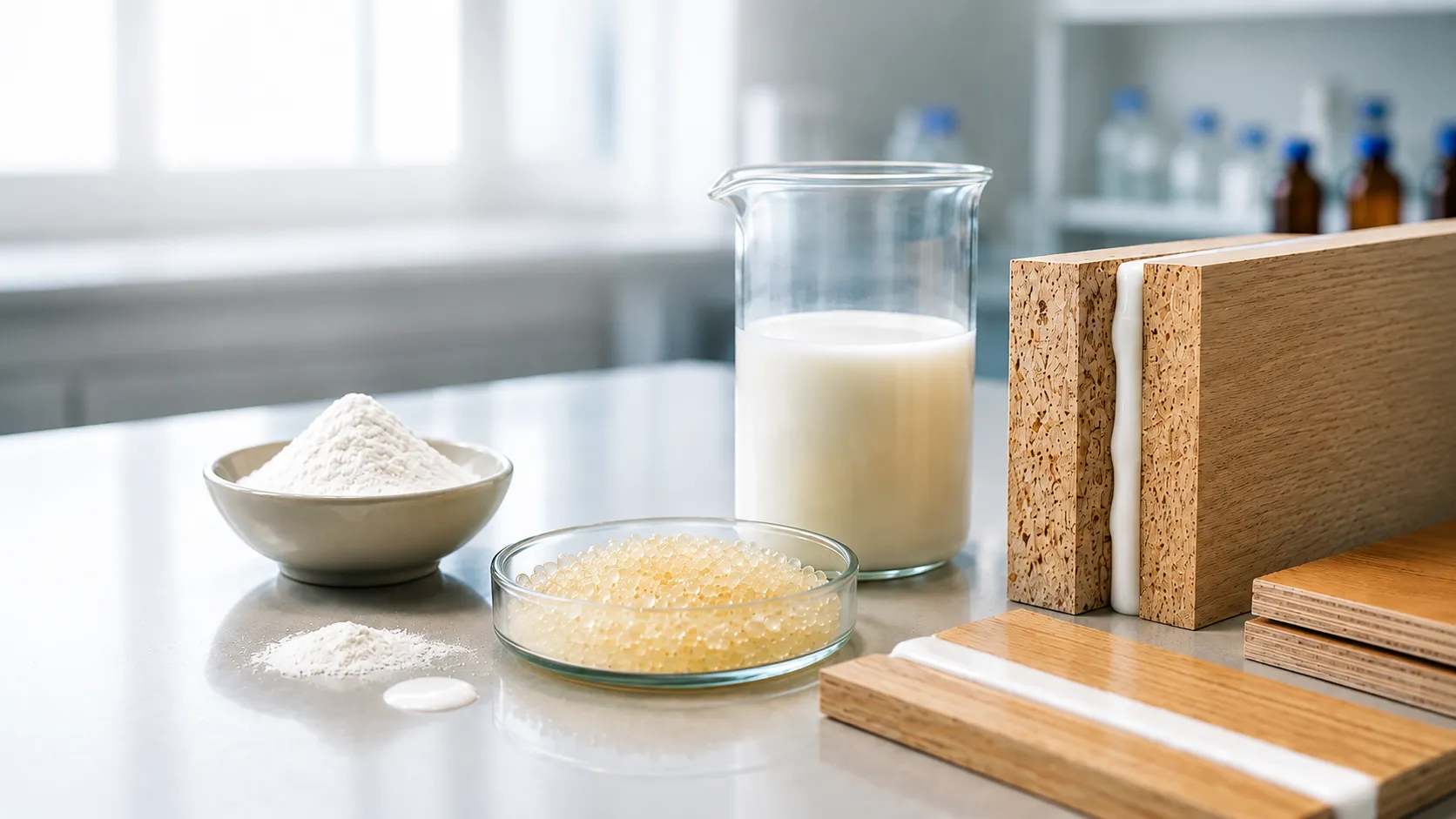
Wood Adhesive Manufacturing and Quality Control Overview
Wood adhesive manufacturing requires accurate formulation, controlled processing, and reliable laboratory quality control. Adhesives used in furniture, plywood, MDF, HDF, particleboard, laminated panels, flooring, doors, windows, and engineered wood products must be evaluated from incoming raw materials through formulation, production, stability testing, performance testing, and finished product release.
For most wood adhesive quality control laboratories, the core testing program includes viscosity, pH, density, solids content, moisture where relevant, curing behavior, bond performance, appearance, and storage stability. Common laboratory equipment therefore includes viscometers, pH meters, analytical balances, mixers and stirrers, moisture analyzers, drying ovens, density meters, universal testing machines, stability chambers, and analytical instruments where formulation or resin verification is required.
This guide explains the wood adhesive manufacturing process, the quality control tests used at different production stages, and how to select laboratory equipment for routine QC, formulation development, and more advanced adhesive analysis.
What Are Wood Adhesives?
Wood adhesives are formulated bonding materials designed to permanently or semi-permanently join natural wood, engineered wood products, veneers, laminates, decorative panels, and structural wood components. Depending on the application and adhesive chemistry, the required properties may include bonding strength, moisture resistance, flexibility, heat resistance, chemical resistance, or controlled curing behavior.
Depending on the adhesive type, a formulation may contain synthetic resins, polymer emulsions, purified water, crosslinking agents, catalysts, fillers, plasticizers, tackifiers, preservatives, anti-foaming agents, thickeners, pH modifiers, stabilizers, and other functional additives.
Common wood adhesive categories include:
- Polyvinyl Acetate (PVA) Adhesives
- Urea Formaldehyde (UF) Resins
- Melamine Urea Formaldehyde (MUF) Resins
- Phenol Formaldehyde (PF) Resins
- Polyurethane (PUR) Adhesives
- Epoxy Adhesives
- Hot Melt Adhesives
- Contact Adhesives
- Pressure Sensitive Adhesives
- Bio-based Wood Adhesives
The appropriate quality control program depends on the adhesive chemistry and intended application. Routine liquid-product QC may focus on viscosity, pH, density, solids, and appearance, while performance-oriented laboratories may also evaluate curing behavior, bond strength, environmental resistance, and formulation identity.
Main Raw Materials Used in Wood Adhesive Manufacturing
Raw material quality can influence adhesive viscosity, curing behavior, bonding performance, formulation stability, and shelf life. Incoming materials should therefore be checked against approved specifications before they are released to production.
Typical raw materials used in wood adhesive manufacturing include:
- Synthetic resins
- Polymer emulsions
- Purified water
- Crosslinking agents
- Catalysts
- Fillers
- Plasticizers
- Tackifiers
- Anti-foaming agents
- Preservatives
- Stabilizers
- Thickeners
- pH adjusters
- Functional additives
- Performance modifiers
Incoming testing may include appearance inspection, viscosity measurement, density determination, pH measurement, moisture content determination, solids content measurement, and identity or composition verification where the raw material and quality plan require analytical confirmation.
Wood Adhesive Manufacturing Process and QC Stages
Wood adhesive manufacturing normally combines controlled material addition, mixing, temperature management, homogenization, in-process testing, final adjustment, and product release. Laboratory testing at each relevant stage helps confirm that the batch remains consistent with the approved formulation and production specifications.
| Production Stage | Main QC Requirement | Typical Laboratory Equipment |
|---|---|---|
| Raw Material Inspection | Identity, viscosity, pH, density, moisture, solids, appearance | Analytical Balance, Brookfield Viscometer, pH Meter, Density Meter, Moisture Analyzer, FTIR where required |
| Formulation Development | Accurate dosing, mixing behavior, dispersion, viscosity development | Analytical Balance, Magnetic Stirrer, Hot Plate Stirrer, Laboratory Mixer, Overhead Stirrer, Homogenizer |
| Ingredient Blending | Addition sequence, temperature, viscosity, solids, batch uniformity | Laboratory Mixer, Overhead Stirrer, Temperature Probe, Brookfield Viscometer, Analytical Balance |
| Homogenization | Dispersion, homogeneity, viscosity, density, appearance | Homogenizer, Overhead Stirrer, Brookfield Viscometer, Density Meter |
| In-Process QC | Viscosity, pH, density, solids, temperature, appearance | Brookfield Viscometer, pH Meter, Density Meter, Drying Oven, Analytical Balance, Temperature Probe |
| Final Product Release | Final specification verification and batch release | Equipment selected according to the finished-product QC specification |
Raw Material Inspection
Before production starts, incoming raw materials should be checked against approved specifications. This step helps identify unsuitable materials before they affect formulation stability, viscosity, curing behavior, or batch consistency.
Common raw material quality control tests include:
- Appearance inspection
- Viscosity measurement
- Density determination
- Moisture content determination
- pH measurement
- Solids content determination
- Purity and resin identity verification where required
Recommended laboratory equipment for raw material inspection:
- Analytical Balance – Used for accurate weighing of raw materials, standards, and laboratory samples.
- Brookfield Viscometer – Measures resin or liquid-component viscosity for incoming quality verification and formulation control.
- Laboratory pH Meter – Measures the acidity or alkalinity of aqueous raw materials and water-based adhesive systems.
- Density Meter – Determines the density of liquid resins and adhesive components for consistency verification.
- Moisture Analyzer – Measures moisture content in fillers, powders, and hygroscopic raw materials where moisture control is relevant.
- FTIR Spectrometer – Supports polymer or resin identity verification when analytical confirmation is part of the incoming inspection program.


Formulation Development and Laboratory Mixing
After raw materials are approved, ingredients are weighed and combined according to the formulation. During laboratory development, the formulation team may evaluate ingredient compatibility, resin concentration, filler loading, catalyst dosage, mixing conditions, addition sequence, viscosity development, curing behavior, and final bonding performance.
Laboratory-scale preparation allows formulation changes to be evaluated before pilot or industrial-scale production. The appropriate mixing equipment depends particularly on batch size, formulation viscosity, dispersion requirements, and whether controlled heating is needed.
Recommended laboratory equipment for formulation development:
- Magnetic Stirrer – Used for laboratory-scale mixing, sample preparation, solution blending, and lower-viscosity formulation trials.
- Hot Plate Stirrer – Provides simultaneous heating and stirring when controlled laboratory heating is required.
- Laboratory Mixer – Produces homogeneous mixtures of resins, fillers, and additives during formulation development.
- Overhead Stirrer – Provides controlled mechanical mixing for formulations that require more torque than magnetic stirring can provide.
- Laboratory Homogenizer – Supports dispersion and formulation uniformity where higher-shear processing is appropriate.


Resin Preparation and Ingredient Blending
After the laboratory formulation has been verified, the adhesive enters resin preparation and ingredient blending. Depending on the adhesive type, resins, polymer emulsions, fillers, plasticizers, tackifiers, catalysts, preservatives, anti-foaming agents, and other functional additives are incorporated according to the approved formulation.
Control of ingredient addition, mixing conditions, processing temperature, and blending time is important for maintaining a homogeneous formulation. Deviations during this stage can produce inconsistent dispersion, viscosity changes, or undesirable curing behavior.
Common process checks include:
- Ingredient sequence verification
- Mixing temperature monitoring
- Mixing uniformity inspection
- Viscosity monitoring
- Solid content verification
- Batch consistency assessment
Recommended laboratory equipment:
- Laboratory Mixer – Provides controlled blending of resins, fillers, and functional additives.
- Overhead Stirrer – Provides mechanical agitation for formulations requiring higher mixing torque.
- Hot Plate Stirrer – Supports laboratory preparation when simultaneous controlled heating and mixing are required.
- Temperature Probe – Monitors processing temperature during laboratory or process checks.
- Brookfield Viscometer – Measures formulation viscosity during blending and in-process verification.
- Analytical Balance – Supports accurate weighing of catalysts, preservatives, curing agents, fillers, and performance modifiers.
Mixing and Homogenization
Following ingredient blending, additional mixing or homogenization may be used to achieve the required dispersion and formulation uniformity. The need for homogenization depends on the adhesive system, filler content, particle dispersion requirements, and production process.
Common process checks include:
- Homogeneity evaluation
- Particle dispersion assessment where relevant
- Viscosity verification
- Density confirmation
- Appearance inspection
- Air bubble evaluation
Recommended laboratory equipment:
- Laboratory Homogenizer – Supports higher-shear dispersion where the formulation requires improved particle or additive distribution.
- Overhead Stirrer – Maintains controlled mechanical mixing, particularly for formulations with higher viscosity.
- Brookfield Viscometer – Confirms viscosity after mixing or homogenization.
- Density Meter – Supports formulation and batch consistency checks.
- Laboratory Microscope – May support investigation of visible particles, agglomerates, or dispersion-related formulation defects when microscopic examination is useful.

In-Process Quality Control During Production
In-process quality control is performed while the adhesive batch is being manufactured. Representative samples are tested at defined production stages to determine whether the formulation remains within approved specifications before final adjustment, filling, and packaging.
Routine process monitoring can identify deviations before they affect an entire production batch and provides data for batch-to-batch consistency.
Common in-process quality control parameters include:
- Viscosity monitoring
- pH verification where applicable
- Density measurement
- Appearance inspection
- Solid content determination
- Temperature monitoring
Recommended laboratory equipment:
- Brookfield Viscometer – Measures adhesive viscosity during production to monitor flow behavior and batch consistency.
- Laboratory pH Meter – Confirms pH where pH is a controlled parameter for the adhesive system.
- Density Meter – Verifies density and supports comparison between production batches.
- Drying Oven – Supports gravimetric solids-content determination when used with an appropriate laboratory method.
- Analytical Balance – Provides accurate mass measurements for routine QC procedures.
- Temperature Probe – Monitors process or sample temperature where temperature affects production control or measurement consistency.
Cooling and Addition of Functional Additives
Where the formulation process requires cooling before final additive addition, temperature-sensitive components can be incorporated after the batch reaches the appropriate processing condition. The exact sequence depends on the adhesive chemistry and approved manufacturing formulation.
Common quality checks include:
- Cooling temperature verification
- Final viscosity measurement
- pH adjustment where required
- Appearance inspection
- Batch homogeneity evaluation
Recommended laboratory equipment:
- Laboratory pH Meter – Measures formulation pH when pH adjustment or verification is required.
- Brookfield Viscometer – Confirms final viscosity before the adhesive proceeds to final release and packaging.
- Magnetic Stirrer – Supports gentle laboratory-scale mixing for suitable lower-viscosity samples and additive trials.
- Temperature Probe – Monitors cooling and sample temperature.
Filling, Packaging, and Final Product Release
Once the batch has completed production and laboratory approval, the finished adhesive is transferred into suitable packaging. Depending on product type and customer requirements, wood adhesives may be supplied in bottles, cartridges, pails, drums, intermediate bulk containers (IBCs), or industrial tanks.
Final release testing should compare the finished batch with its approved product specification. The exact release panel depends on adhesive chemistry and intended use.
Common final quality control checks include:
- Final viscosity measurement
- Density verification
- pH measurement where applicable
- Appearance and color inspection
- Solid content determination
- Packaging compatibility evaluation where required
- Label verification
- Retention sample collection
Only batches meeting the manufacturer’s predefined release specifications should proceed to commercial distribution.
Stability Testing and Shelf Life Evaluation
Stability testing evaluates whether a wood adhesive maintains acceptable physical and application properties during its intended storage period. Depending on the formulation and quality program, studies may investigate the effects of storage time, temperature, humidity, transportation conditions, or packaging.
Stability programs may include long-term storage, accelerated aging, freeze-thaw evaluation where relevant, high- or low-temperature storage, viscosity monitoring, phase-separation assessment, pH monitoring, density measurement, and appearance evaluation.
Recommended laboratory equipment for stability testing:
- Stability Test Chamber – Provides controlled environmental conditions for stability studies where defined temperature and humidity exposure is required.
- Environmental Chamber – Supports environmental exposure studies under controlled temperature and humidity conditions.
- Laboratory Refrigerator – Provides controlled low-temperature storage for formulations requiring refrigerated or low-temperature evaluation.
- Brookfield Viscometer – Monitors viscosity changes during storage studies.
- Laboratory pH Meter – Monitors pH where pH stability is relevant to the adhesive system.
- Density Meter – Supports comparison of formulation density during stability evaluation.


Physical and Mechanical Performance Testing
Routine laboratory testing should verify the characteristics that matter to the finished adhesive and its intended wood application. The required test panel therefore varies with adhesive chemistry, substrate, manufacturing process, application conditions, and customer specifications.
Performance evaluation may include viscosity, solids content, density, pH, gel or curing behavior, bond strength, water resistance, heat resistance, shear strength, peel strength, and film or cured-adhesive observations where relevant.
Recommended laboratory equipment for performance testing:
- Brookfield Viscometer – Measures adhesive viscosity for formulation, process, and finished-product QC.
- Universal Testing Machine (UTM) – Supports mechanical testing of prepared adhesive joints using the appropriate specimen, fixture, and test procedure.
- Laboratory pH Meter – Measures pH of applicable water-based adhesive formulations.
- Drying Oven – Supports solids-content determination and laboratory heating procedures where required by the test method.
- Analytical Balance – Provides accurate mass measurement for sample preparation and gravimetric procedures.
- Density Meter – Supports density measurement and batch comparison.
Resin Composition and Functional Additive Analysis
Instrumental analysis can support wood adhesive laboratories when routine physical QC is not sufficient to answer a formulation or raw-material question. These techniques are particularly useful in formulation development, incoming material verification, troubleshooting, and investigations that require more information about chemical identity or selected components.
Not every production laboratory requires the same analytical instrumentation. The need for advanced analysis should be based on adhesive chemistry, raw material risk, R&D requirements, troubleshooting needs, and the laboratory’s validated analytical methods.
Recommended analytical instruments for resin analysis:
- FTIR Spectrometer – Supports identification or comparison of polymers, resins, and other materials through infrared spectral analysis.
- UV-Visible Spectrophotometer – Can support concentration or comparative analysis for selected components when a suitable analytical method is available.
- Moisture Analyzer – Measures moisture content in suitable powders, fillers, and hygroscopic raw materials.
- Analytical Balance – Supports accurate weighing during analytical procedures and sample preparation.
- Drying Oven – Supports gravimetric solids-content and other laboratory heating procedures where applicable.

Key Quality Control Tests for Wood Adhesives
Wood adhesive quality control should connect each test with a clear production or performance objective. The final testing program should be defined according to adhesive type, resin chemistry, manufacturing process, end-use application, and approved product specifications.
| Quality Control Test | Purpose | Common Laboratory Equipment | Relevant Adhesive Types |
|---|---|---|---|
| Viscosity Testing | Evaluates flow behavior, processing characteristics, application consistency, and batch variation. | Brookfield Viscometer | Many liquid adhesive systems |
| Solid Content Determination | Determines the non-volatile fraction of applicable liquid formulations. | Drying Oven, Analytical Balance | Applicable liquid adhesive systems |
| pH Testing | Monitors acidity or alkalinity where pH is a formulation or release parameter. | Laboratory pH Meter | Primarily applicable aqueous systems |
| Bond Strength Testing | Evaluates the mechanical performance of prepared adhesive joints. | Universal Testing Machine | Adhesives requiring mechanical bond-performance verification |
| Water Resistance Testing | Evaluates bond performance after defined moisture or water exposure. | Environmental conditioning equipment and mechanical test equipment as required by the procedure | Adhesives intended for moisture-resistant applications |
| Thermal / Environmental Stability | Evaluates changes after controlled environmental exposure. | Stability Test Chamber or Environmental Chamber | Formulations requiring environmental or storage evaluation |
| Resin Identification | Supports confirmation or comparison of resin and polymer identity. | FTIR Spectrometer | Systems where analytical identity verification is required |
| Moisture Analysis | Determines moisture content in suitable raw materials. | Moisture Analyzer | Powders, fillers, and other moisture-sensitive materials |
| Density Measurement | Supports formulation and batch consistency verification. | Density Meter | Liquid adhesive systems |
| Appearance Evaluation | Identifies visible changes such as color variation, separation, particles, or other formulation abnormalities. | Visual inspection; Laboratory Microscope where detailed investigation is useful | Raw materials and finished adhesive products |
Recommended Laboratory Equipment by Adhesive Type
Different wood adhesive formulations require different combinations of routine and performance tests. Equipment selection should therefore follow the actual adhesive chemistry and release specification rather than assuming that every laboratory needs the same instrument package.
| Wood Adhesive Type | Important Quality Tests | Recommended Laboratory Equipment |
|---|---|---|
| PVA Adhesives | Viscosity, pH, solids content, bond performance | Brookfield Viscometer, Laboratory pH Meter, Drying Oven, Analytical Balance; mechanical test equipment where bond testing is performed |
| UF & MUF Resins | Viscosity, solids, gel or curing behavior | Brookfield Viscometer, Drying Oven, Analytical Balance, temperature-control equipment as required by the test procedure |
| Phenol Formaldehyde Resins | Viscosity, solids, curing behavior, heat or environmental performance where required | Brookfield Viscometer, Drying Oven, Analytical Balance, environmental or thermal conditioning equipment where applicable |
| Polyurethane Adhesives | Moisture-related control where applicable, viscosity, curing and bond performance | Moisture Analyzer for suitable materials, Brookfield Viscometer, Universal Testing Machine where mechanical testing is required |
| Epoxy Adhesives | Component ratio, curing behavior, bond strength | Analytical Balance, Universal Testing Machine, appropriate sample-preparation equipment |
| Hot Melt Adhesives | Thermal handling behavior and viscosity under the required test conditions | Controlled heating equipment and suitable viscosity measurement equipment |
Essential Laboratory Equipment for Wood Adhesive Quality Control Laboratories
A wood adhesive quality control laboratory does not necessarily need every available analytical instrument. The core equipment should first cover the routine tests required for incoming materials, formulation control, in-process monitoring, and finished-product release. More advanced instruments can then be added when the laboratory performs formulation research, troubleshooting, chemical identification, or specialized performance testing.
| Laboratory Equipment | Primary Application | Importance in Wood Adhesive Manufacturing |
|---|---|---|
| Analytical Balance | Accurate weighing of raw materials and laboratory samples | Supports formulation accuracy and repeatable gravimetric testing. |
| Brookfield Viscometer | Viscosity measurement | Supports control of adhesive flow behavior and batch consistency. |
| Laboratory pH Meter | pH measurement | Supports formulation and release control for adhesive systems where pH is a relevant parameter. |
| Magnetic Stirrer | Laboratory mixing | Supports sample preparation and lower-viscosity laboratory formulation work. |
| Hot Plate Stirrer | Heating and mixing | Provides simultaneous laboratory-scale heating and stirring where required. |
| Laboratory Mixer | Ingredient blending | Supports controlled preparation of laboratory formulations before scale-up. |
| Overhead Stirrer | Mechanical mixing | Provides additional mixing torque for formulations that cannot be handled effectively by magnetic stirring. |
| Laboratory Homogenizer | Dispersion | Supports higher-shear dispersion where formulation uniformity requires it. |
| Moisture Analyzer | Moisture determination | Measures moisture content in suitable fillers, powders, and hygroscopic raw materials. |
| Density Meter | Density measurement | Supports formulation and batch consistency monitoring. |
| Drying Oven | Solids determination and controlled heating | Supports gravimetric QC procedures and other applicable laboratory heating steps. |
| FTIR Spectrometer | Material or resin identification | Supports analytical comparison and identity verification where required. |
| UV-Visible Spectrophotometer | Selected chemical analysis | Supports applicable concentration measurements when a validated analytical method is available. |
| Universal Testing Machine | Mechanical bond testing | Supports tensile, shear, peel, or other mechanical tests when configured with appropriate specimens, fixtures, and procedures. |
| Stability Test Chamber | Controlled stability studies | Provides defined environmental conditions for stability evaluation. |
| Environmental Chamber | Environmental conditioning | Supports controlled temperature and humidity exposure for applicable performance studies. |
| Laboratory Refrigerator | Low-temperature storage | Supports controlled low-temperature storage and stability work. |
Basic vs. Advanced Wood Adhesive Laboratory Setup
The appropriate laboratory configuration depends on what decisions the laboratory must make. A production QC laboratory focused on routine batch release can begin with instruments that measure the parameters included in the product specification. An R&D or troubleshooting laboratory may require additional mechanical, environmental, and analytical capabilities.
| Laboratory Level | Typical Testing Focus | Equipment Priorities |
|---|---|---|
| Basic Production QC | Routine incoming, in-process, and finished-product checks | Analytical Balance, Brookfield Viscometer, pH Meter where applicable, Density Meter, Drying Oven, temperature measurement, basic sample-preparation equipment |
| Formulation / R&D Laboratory | Formulation trials, mixing studies, dispersion, curing and comparative performance | Basic QC equipment plus Laboratory Mixer, Overhead Stirrer, Hot Plate Stirrer, Homogenizer, and appropriate performance-testing equipment |
| Advanced Analytical / Performance Laboratory | Material identification, troubleshooting, stability studies, and mechanical performance | Routine QC and formulation equipment plus FTIR, UV-Visible where method-appropriate, Universal Testing Machine, Stability Chamber, or Environmental Chamber as required |
A practical purchasing sequence is to establish the required release tests first, add formulation equipment according to development workload, and then justify advanced analytical instruments based on actual testing or troubleshooting requirements.
Quality Standards and Manufacturing Considerations
Wood adhesive manufacturers should use documented specifications, suitable test methods, calibrated instruments, controlled production records, and defined quality control procedures. These controls help laboratories compare batches consistently and determine whether incoming materials, in-process samples, and finished products meet the manufacturer’s requirements.
The applicable standards and test procedures depend on adhesive chemistry, intended wood application, customer requirements, and target market. Laboratories should therefore identify the specific methods that apply to their products before selecting fixtures, conditioning equipment, instrument configurations, or acceptance criteria.
Calibration, maintenance, method suitability, sample preparation, conditioning, and complete batch documentation should be considered alongside the instrument itself. A technically capable instrument will not produce useful QC data if the sampling and test procedure are inconsistent.
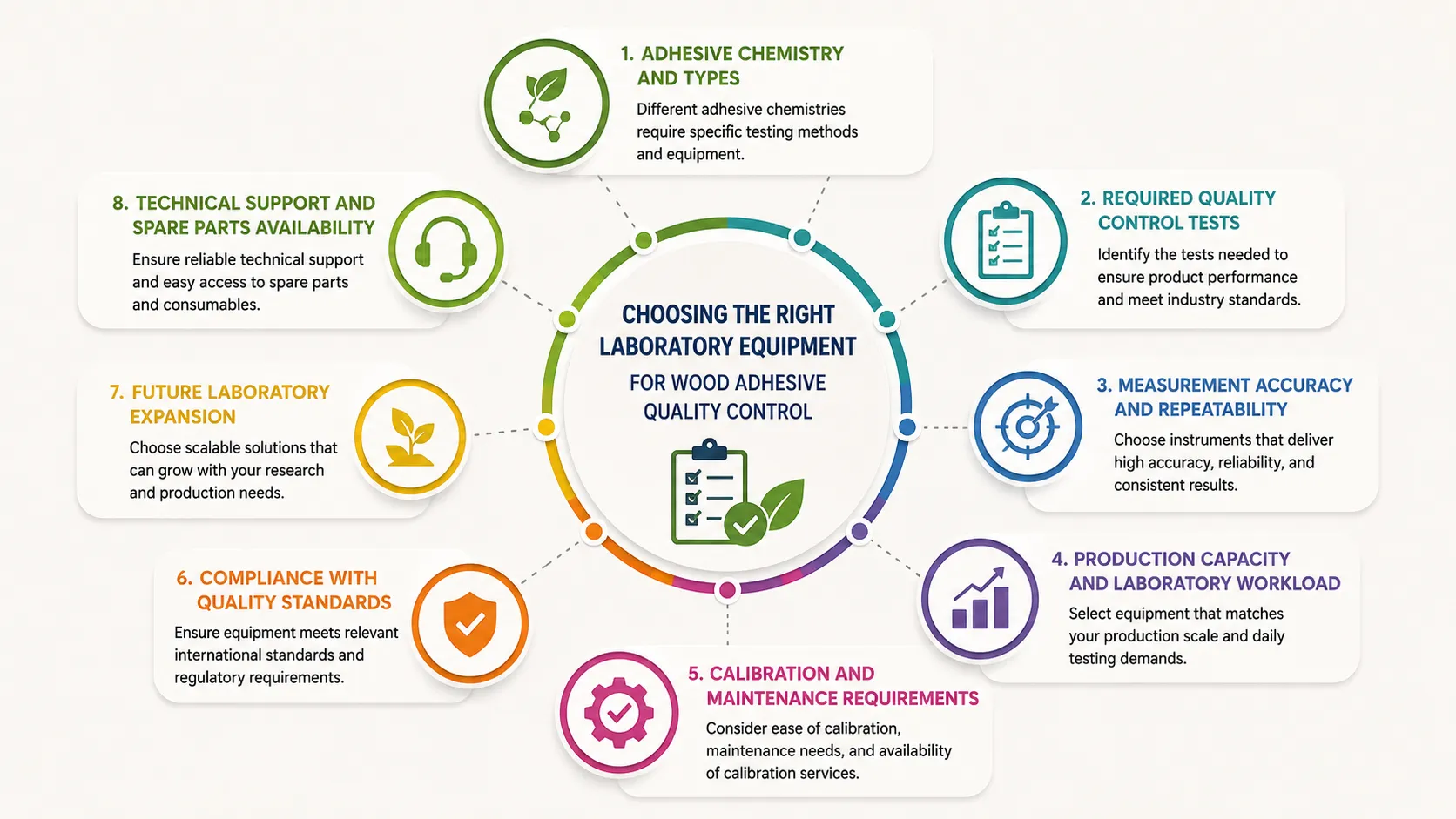
How to Choose Laboratory Equipment for a Wood Adhesive Quality Control Laboratory
Start with the tests the laboratory must perform rather than with a generic equipment list. The correct instrument package depends on the adhesive chemistry, required release parameters, sample volume, formulation-development workload, performance-testing needs, and level of analytical investigation.
Important factors to consider include:
- Adhesive chemistry: PVA, UF/MUF, polyurethane, epoxy, phenolic, hot-melt, and other systems do not require identical QC programs.
- Required quality control tests: Identify the actual incoming, in-process, release, stability, and performance tests before selecting instruments.
- Sample characteristics: Consider whether samples are liquid, high-viscosity, filled, powdered, moisture-sensitive, or require controlled heating or conditioning.
- Measurement repeatability: Select equipment capable of producing consistent results for the laboratory’s approved method.
- Sample throughput: Production laboratories processing frequent batch samples may prioritize faster, repeatable routine measurements.
- Mechanical testing requirements: Bond-performance testing requires appropriate specimens, fixtures, conditioning, and test procedures in addition to the testing machine.
- Calibration and maintenance: Consider calibration requirements, routine verification, cleaning, service, and instrument maintenance.
- Laboratory workload and staffing: Equipment complexity should match the laboratory’s testing volume and technical capabilities.
- Advanced analytical need: FTIR, UV-Visible analysis, environmental conditioning, and other advanced capabilities should be selected when they solve a defined QC, R&D, or troubleshooting requirement.
- Future laboratory expansion: Consider whether future formulations or testing programs are likely to require additional capabilities.
- Technical support and spare parts: Long-term instrument support is an important part of laboratory equipment selection.
For a new laboratory, the most useful approach is usually to define the adhesive products, list the required tests for each production stage, identify which tests are routine versus occasional, and then map each requirement to the appropriate equipment family. This avoids both under-equipping the laboratory and purchasing advanced instruments that do not support a defined testing need.
Frequently Asked Questions (FAQ)
What tests are commonly used for wood adhesive quality control?
Common tests include viscosity, solids content, density, pH where applicable, appearance, moisture analysis for relevant raw materials, curing or gel behavior where required, bond-performance testing, and stability evaluation. The exact test panel depends on the adhesive chemistry and approved product specification.
Which laboratory equipment is most important for routine wood adhesive QC?
A routine production laboratory commonly prioritizes an Analytical Balance, Brookfield Viscometer, Laboratory pH Meter where applicable, Density Meter, Drying Oven, temperature measurement equipment, and suitable sample-preparation tools. Additional equipment should be selected according to the actual release and performance tests required.
Why is viscosity measurement important for wood adhesives?
Viscosity is an important process and application parameter for many liquid adhesives because it helps laboratories monitor flow behavior and batch consistency. Measurements should be made under controlled, repeatable test conditions so that production batches can be compared meaningfully.
How is wood adhesive bond strength tested?
Bond-performance testing uses prepared adhesive joints and an appropriate mechanical test procedure. A Universal Testing Machine may be used for tensile, shear, peel, or related mechanical measurements when equipped with the appropriate specimens and fixtures. The exact procedure depends on the adhesive application and applicable test method.
How is adhesive shelf life evaluated?
Shelf-life evaluation uses defined storage conditions and scheduled testing over time. Laboratories may monitor viscosity, pH where relevant, density, appearance, phase separation, and other product-specific performance parameters during long-term or accelerated stability studies.
When is FTIR useful in a wood adhesive laboratory?
FTIR is useful when the laboratory needs analytical support for resin or polymer identity verification, raw-material comparison, formulation development, or troubleshooting. It is an advanced analytical capability rather than a universal requirement for every routine production QC laboratory.
What equipment should a new wood adhesive QC laboratory buy first?
Start with the instruments required by the product’s routine incoming, in-process, and finished-product specifications. For many liquid adhesive laboratories, this means prioritizing weighing, viscosity, pH where applicable, density, solids-content, temperature, and sample-preparation capabilities before adding advanced analytical or performance-testing equipment.
Conclusion
Effective wood adhesive quality control begins by connecting each production stage with the tests needed to make a manufacturing or release decision. Incoming materials may require identity, moisture, viscosity, pH, or density checks; production batches require controlled formulation and in-process monitoring; and finished adhesives may require physical, mechanical, stability, or analytical evaluation depending on their chemistry and intended application.
For routine production laboratories, core equipment such as Analytical Balances, Brookfield Viscometers, pH Meters where applicable, Density Meters, Drying Ovens, and suitable mixing and sample-preparation equipment provides the foundation for consistent QC. Universal Testing Machines, stability or environmental chambers, FTIR Spectrometers, and other advanced instruments should be added when mechanical performance, environmental conditioning, material identification, R&D, or troubleshooting creates a defined testing requirement.
The most effective laboratory configuration is therefore not the laboratory with the largest equipment list. It is the one in which each instrument is tied to a required test, each test supports a production or quality decision, and the complete testing program matches the adhesive products being manufactured.


