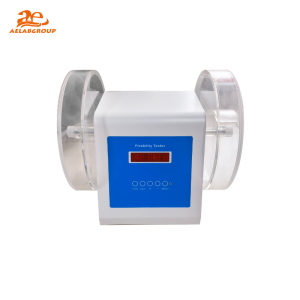
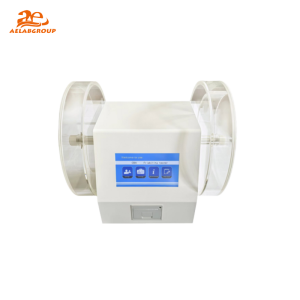
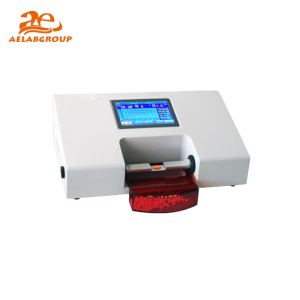
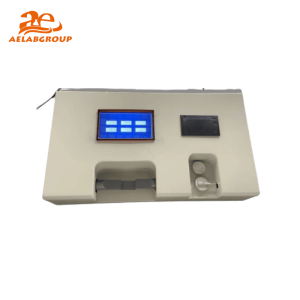
Overview
A tablet friability tester evaluates the durability of tablets by measuring their resistance to abrasion and breakage. Tablets are placed in a rotating drum that simulates real-world handling conditions. The drum rotates for a specified time, after which the tablets are removed and weighed to assess weight loss due to chipping or breaking. This test helps ensure that tablets remain intact during packaging, shipping, and handling, maintaining their quality and effectiveness.
Features:
- Automation: auto-test, auto-diagnose, auto-alarm.
- Intelligently control the rotating speed of cylinder and revolutions.
- One drum runs synchronously. Auto stop at timing point. (only for AE-CS-IV)
- Single path and double cylinder, synchronous operation and automatic stop.
- The revolution of the drum can be preset at any time, either preset or real data is displayed on the LCD.
- Microprocessor unit is used to control all operations, high accuracy is achieved in testing rotary speed and circle number.
Recommended Models by Use Case
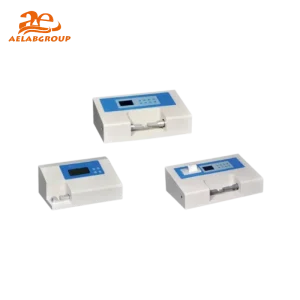
- CS-I / CS-III – Dual drum design ideal for high-throughput QC labs requiring simultaneous testing.
- CS-II – Simplified single drum, perfect for academic or small-scale R&D labs.
- CS-IV – Advanced model with auto-stop and intelligent timing, great for GMP-compliant pharmaceutical production.
Ideal For
Pharmaceutical QA/QC departments
GMP-compliant manufacturing labs
University and academic research labs
Tablet formulation development centers
Perfect for any laboratory needing accurate friability testing aligned with USP <1216> and other global standards.
FAQ – Lab-Focused
Q: Does the AELAB CS Series comply with USP and international standards?
Yes, it’s designed in accordance with USP <1216> and related global pharmacopoeias.
Q: Can I test different tablet sizes and weights?
Absolutely. The adjustable rotation settings accommodate a variety of tablet types.
Q: What makes AELAB different from other lab equipment brands?
AELAB focuses on precision, reliability, and advanced automation—ideal for labs demanding consistent, repeatable results.
Q: Is maintenance required frequently?
Minimal maintenance is needed. Its microprocessor-based control reduces wear and extends operational life.